Out-of-bounds & obstacle collision
track_gen.collision answers two questions every batched sim asks: did
the agent leave the drivable band? and did it hit a point obstacle?
Out-of-bounds checking
track_gen.collision.CollisionChecker answers, per oriented box, whether
it left the drivable band — with signed clearance, nearest boundary point,
and inward normal. Two backends: the exact segments scan (default; no
precompute, reads regenerated tracks automatically) and baked sdf grids
(O(1) queries after a per-regeneration bake(); distances accurate to
about one grid cell). See Performance below for measured numbers; the rule
of thumb: segments unless a track batch serves hundreds of queries
between regenerations.
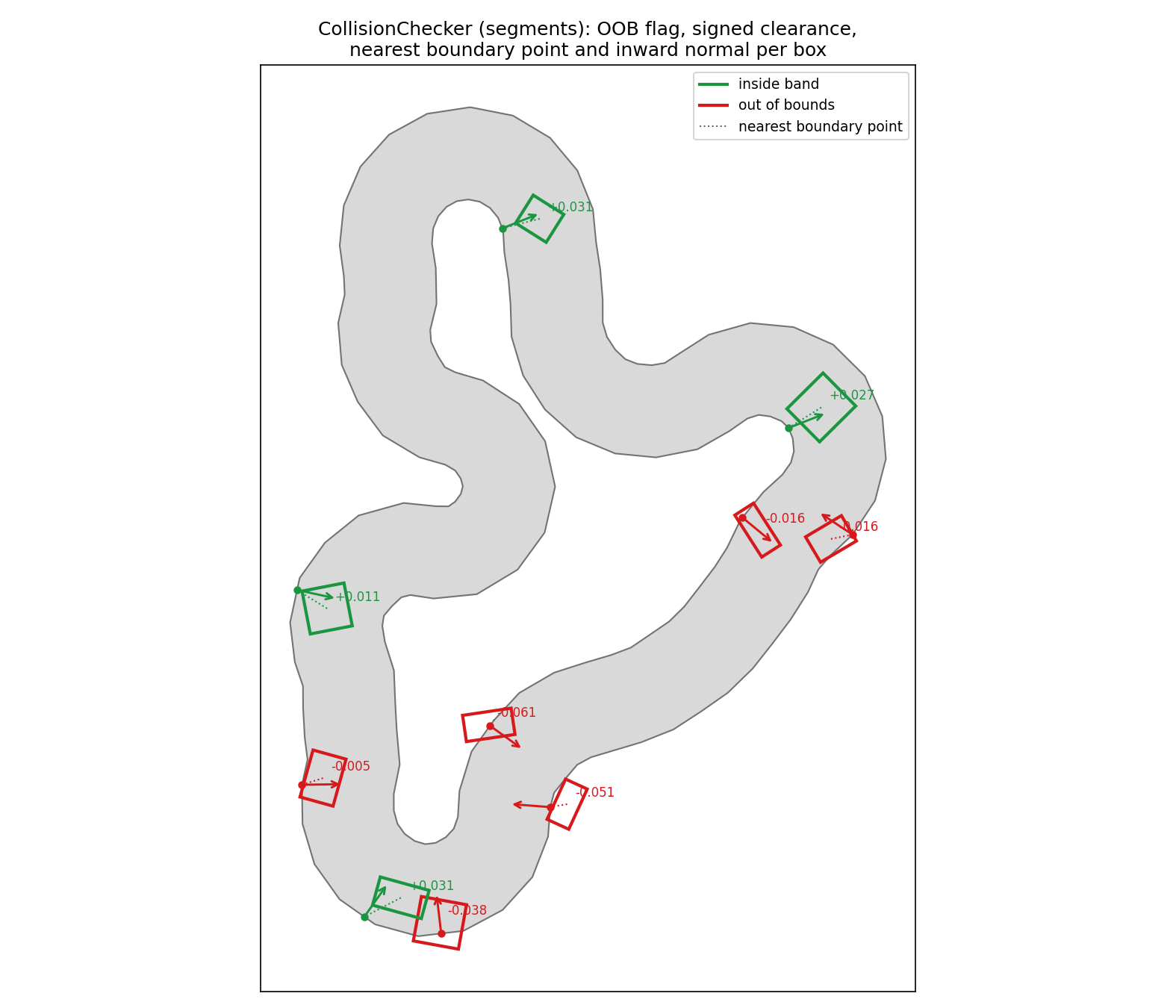
The full per-box contact report: OOB flag (color), signed clearance (label), nearest boundary point (dotted) and inward normal (arrow).
Performance
Measured with benchmarks/benchmark_collision.py on an RTX 4090
(warp-lang 1.14, E = 8192 generated tracks × 8 boxes = 65,536 box queries
per call, default TrackGenConfig):
backend |
eager / query |
graph replay / query |
precompute per regeneration |
|---|---|---|---|
|
~0.32 ms |
~0.29 ms |
none |
|
~0.053 ms |
~0.025 ms |
~49 ms |
Accuracy of sdf against the exact backend on the same workload: the
signed-distance error is typically ~2% of a grid cell (p99 < 0.4 cells);
OOB flags agree on 99.6% of boxes, disagreeing only inside the ±1-cell band
around zero clearance. SDF normals are noisy near the middle of the band
(medial axis) and at sharp features — prefer segments when normals or
nearest points drive a contact response.
Rule of thumb: segments is the default — exact, no memory, no rebake,
and already ~5 ns per box. Switch to sdf when a track batch serves more
than roughly 200 queries between regenerations and only the OOB flag and
approximate clearance are consumed (e.g. RL reward shaping).
Reproduce:
python -m benchmarks.benchmark_collision --E 8192
Disc obstacles (gate posts, cones)
track_gen.collision.DiscChecker checks oriented boxes against disc
obstacles. Gate posts are two lines of code:
import numpy as np, warp as wp
from track_gen.collision import DiscChecker

dev = seq.left.device                       # bind posts on the same device
posts = np.empty((E, 2 * G, 3), np.float32)
posts[:, 0::2] = seq.left.numpy().reshape(E, G, 3)
posts[:, 1::2] = seq.right.numpy().reshape(E, G, 3)
checker = DiscChecker(wp.array(posts.reshape(-1, 3), dtype=wp.vec3f,
                               device=dev),
                      radius=0.03, max_boxes=1, num_envs=E)
NaN padding in the gate arrays carries over and NaN discs are skipped, so no
per-env count bookkeeping is needed. A hit reports the deepest disc; for
interleaved posts, gate = disc // 2.
posts is a host-side snapshot taken via .numpy() — it does NOT alias
seq.left/seq.right, so a later regeneration is invisible to it;
rebuild posts (repeat this recipe) after every generate(). The
Course facade’s built-in post_radius option does this rebuild
device-side, automatically, on every generate().
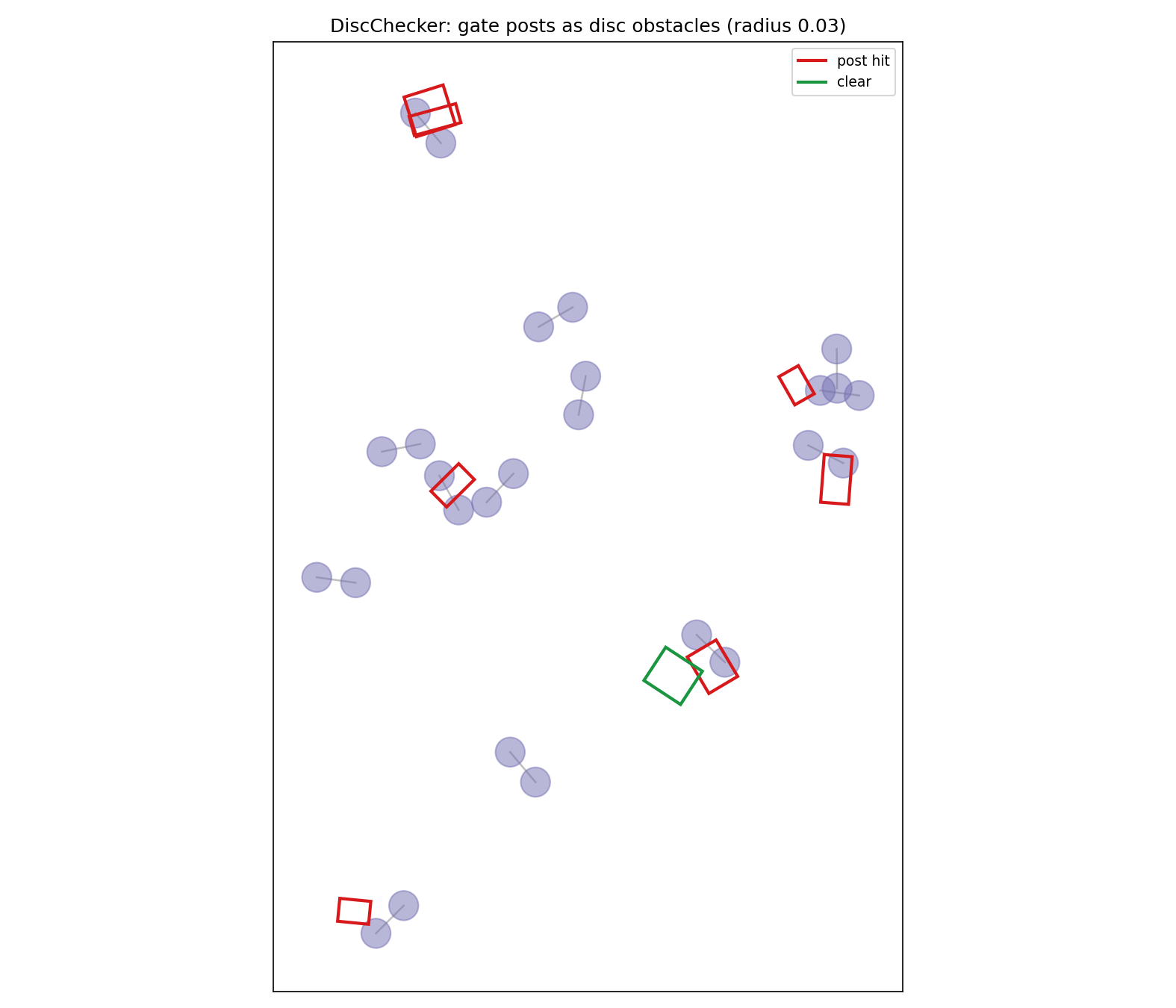
Gate posts as discs; the same checker makes cones physical.
API: track_gen.collision.CollisionChecker,
track_gen.collision.DiscChecker — see the
API reference.