Pipeline — data-flow overview
The track_gen pipeline turns a batch of per-environment seeds into a batch of
Track objects. The whole pipeline lives in
track_gen/_src/warp_pipeline.py (plus the relaxation solve in
track_gen/_src/warp_relax.py) and is written entirely in
NVIDIA Warp kernels.
Goals
No torch/Warp mixing. One implementation. Every pipeline stage is a Warp kernel. Runtime package imports do not depend on torch; tests and diagnostics may bridge via
wp.from_torch/wp.to_torchat the boundary.One codebase, two devices. Warp kernels run on the Warp
cpudevice (GPU-free, for tests/CI) and oncuda(production). The same code path serves both.A single replayable CUDA graph for capturable generators. When
GeneratorSpec.capturable=True, the pipeline is static (fixed shapes, fixed iteration counts, no host-side branching on tensor data) and captures into one replayable CUDA graph.repulsiveis host-controlled/eager and does not capture a CUDA graph.
Data flow
seeds[E]
  │  CENTERLINE GENERATION  (registered config.generator:
  │    "bezier", "hull", "polar", "voronoi", "checkpoint", or "repulsive";
  │    single pass, generator-private scratch, no regen loop, no generation gate)
  ▼
centerline[E, num_points, 2]     (every env real) + valid[E] (all True —
  │                                 final geometric validity is decided post-relax by INFLATE)
  │  RESAMPLE   resample_constant_spacing → per-track count[e] = ⌊perimeter/spacing⌋+1, capped at N_max
  ▼
spaced[E, N_max, 2]              (NaN-padded past each track's count[e])
  │  RELAX      (XPBD: separation + spacing + bending, fixed iters, double-buffered,
  │              count-aware, Chebyshev-accelerated)
  ▼
relaxed[E, N_max, 2]
  │  INFLATE    resample_uniform (re-uniformize) ─► frame+curvature ─► constant-width offset
  │             ─► validity ─► arclength
  ▼
Track(outer, center, inner, tangent, normal, arclen, length, valid, count, winding)
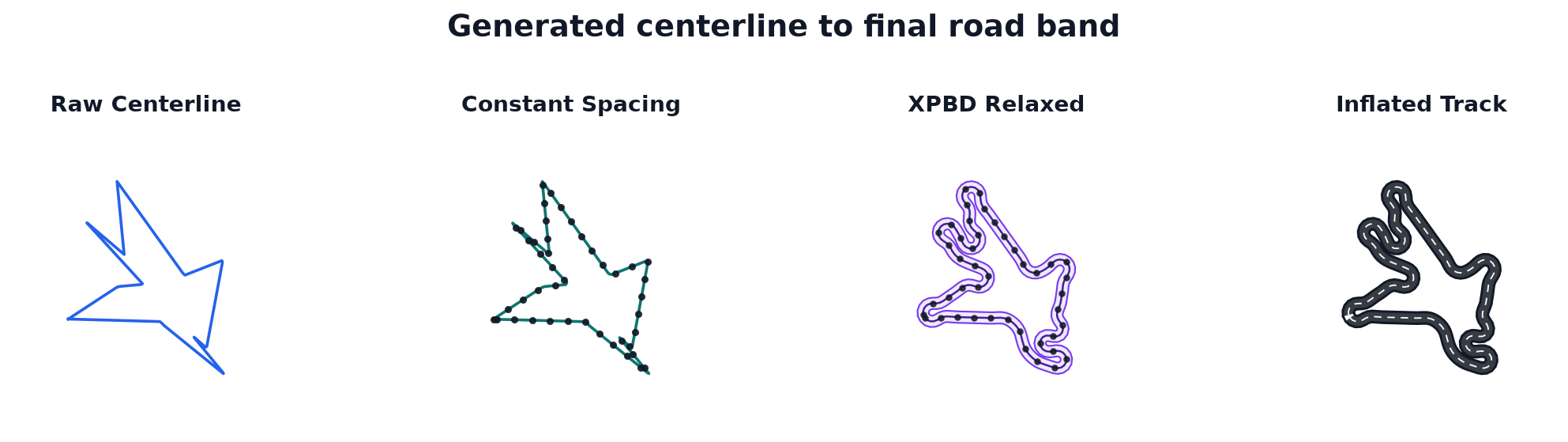
The four pipeline stages: generation, resample, relax, and inflate.
The RELAX stage — the XPBD constraint solve that makes the centerline inflatable — has its own section: see Track relaxation — overview.
Registered centerline generators
The centerline generator is pluggable. TrackGenerator.__init__ resolves
config.generator through track_gen._src.generator_registry, allocates that
generator’s private scratch once, and _run_pipeline calls the resolved
GeneratorSpec.generate with orchestrator-owned out_centerline and
out_valid_wp buffers. The production runtime registry currently exposes:
generator |
module |
representation |
local handling / execution |
|---|---|---|---|
|
|
sampled grid corners → angle-sorted closed cubic Bezier |
selected corner-polygon fallback for Bezier self-crossers |
|
|
angle-sorted point loop → displaced midpoints → closed Catmull-Rom |
selected augmented-polygon fallback for Catmull-Rom self-crossers |
|
|
sorted polar control knots → periodic Catmull-Rom spline |
no generator-local fallback; downstream relaxation/inflation gates final validity |
|
|
fixed site field → angular anchor cycle → smoothed graph-cycle loop |
selected anchor-polygon fallback for smooth-loop self-crossers |
|
|
radial checkpoints → bounded-turn steering → additive heading-ramp closure |
best-of-K candidate selection (default K=4); optional single-crossing clip fallback (off by default) |
|
|
obstacle-seeded disc → tangent-point/Sobolev growth |
host-controlled/eager; no CUDA graph |
Every registered runtime generator follows the same hard contract:
alloc_scratch(config)allocates fixed-shape, generator-private Warp buffers once.generate(seeds_wp, config, out_centerline, out_valid_wp, scratch)writes an[E*num_points]closed centerline into the supplied output buffer and writes[E]generation flags.The hot path is pure Warp, zero allocation, deterministic in
(seed, config), and graph-capturable: no host-side retry loop, no host branch on generated tensor data, and no per-env Python branching. Exception:repulsivedeclaresGeneratorSpec(capturable=False)and is exempt from the allocation and graph-capturable clauses — see Repulsive Generator and the note below.out_valid_wpis filled with1by the current runtime generators. It is a stage flag, not the final quality decision. Turning, thickness, NaNs, width floor, and optional border intersections are judged later byinflate_warpafter constant-spacing and XPBD relaxation.
Per-generator algorithm details are covered in the individual generator deep-dive pages (bezier, hull, polar, voronoi, checkpoint, repulsive).
Determinism, yield, and FP tolerance
Determinism. Warp’s per-env RNG is deterministic, so a given seed buffer reproduces the
same tracks run-to-run on a device. The cpu and cuda RNG streams may differ — each
device is internally reproducible; cross-device yields are compared statistically, not
per-env. This holds for all six generators including repulsive (the one
capturable=False generator): its growth gradient is hand-written analytic adjoints — a
per-vertex gather with no atomics — so it is byte-identical run-to-run on both cpu and
cuda, per seed. As with every generator, cross-device output is statistically
equivalent (same yield and compactness band) but not bit-identical, since fp32 rounding
differs between CPU and CUDA. See track_gen/_src/warp_generate_repulsive.py’s module
docstring for the full account.
Yield. Relaxed-valid yield is approximately 0.999 end-to-end (E ≥ 2048): ≈ 0.9991
at the fat-band default (half_width=0.5, scale=10, spacing=0.30,
N_max=384), ≈ 0.9955 at the library default config, ≈ 0.9998 in the thin
(half_width=0.03) regime — all measured at E=8192. Two changes got it there:
Constant spacing made relaxation lossless. The old
fixed-256 ceiling (≈ 0.68 in the fat-band regime) was slow-Jacobi under-convergence from over-resolution, not un-relaxable geometry: at 256 points the centerline is over-resolved relative to its half-width, so the fixed iteration count cannot drive the Jacobi solve to convergence. Relaxing at ~0.6×half_width spacing (≈ 145–160 nodes/track, not 256) lifted that same regime 0.684 → 0.999 — and runs faster (fewer nodes), while staying graph-capturable.Single-pass centerline generation replaced the regen loop. With relaxation lossless, the default Bezier residual was a small fraction of smooth-centerline self-crossers. Rather than a fixed
max_regen_itersaccept-first-valid loop, the Bezier generator now takes one corner draw per env and routes any track whose smooth Bezier centerline self-crosses to its provably simple corner polygon, which XPBD re-rounds. Thehullgenerator follows the same selected-polygon rescue pattern for its Catmull-Rom self-crossers,voronoifalls back to its selected anchor polygon for smooth-loop crossings,checkpointuses bounded best-of-K selection with an optional single-crossing clip fallback, andpolaremits a closed radial spline with no generator-local fallback.max_regen_itersis therefore vestigial on the Warp path: it remains aTrackGenConfigfield for the torch oracle but is ignored by_run_pipeline.
FP tolerance and hard thresholds. Validity gates (th_ok, turn_ok) are hard
comparisons; near a decision boundary the accepted ~1e-4 Warp-vs-torch drift can flip a
single env’s bool. Tests keep their inputs away from those boundaries; the end-to-end yield
comparison uses an aggregate tolerance, not per-env equality.