3D gate courses
Gate sequences (GateGenerator, tutorial at Generating Gate Sequences for Drone Courses) are
2.5D: the plan-view layout comes from the proven 2D centerline generators, and
altitude (Z) is layered on afterwards as a first-class profiler stage. The result is a
genuine 3D course — gates carry a vec3f position, a roll-free orientation
quaternion, and can be flown, localized, and collided against in three dimensions —
without giving up any of the 2D generators’ layout quality or determinism. This page
covers the 2.5D design, the four z_profile families and their knobs, the two
gate_align modes, the runtime parity with track mode, the validity rules, and the
breaking changes from the pre-3D API.
Why 2.5D
The 2D gate pipeline is well understood: each native generator (bezier, hull,
polar, voronoi, checkpoint) samples corner anchors, they are ordered and
bounding-box normalized, the gate self-collision solve
separates overlapping gates, and tangents follow. All of that is a plan-view (XY)
computation and stays bit-identical to the 2D era.
Altitude is added as a separate stage that runs on the final ordered, relaxed 2D
anchors — before the lift to vec3f. Concretely, in _run_gate_pipeline
(track_gen/_src/warp_gate.py) the stage order is:
raw anchors → ordering → bbox normalization → SPHERE RELAXATION
    → Z PROFILE (writes per-gate z) → lift to vec3f → tangents → frames + validity
Keeping Z orthogonal to the XY layout is what makes the feature cheap and safe: the
plan-view generators are untouched, the Z stage is a single data-independent kernel
launch (graph-capturable, zero per-call allocation), and turning altitude off
(z_profile="flat" with z_base=0) reproduces the old planar course exactly.
Altitude profiles
GateGenConfig.z_profile selects the altitude family. All four write every real gate
slot and NaN the padding; the z_* knobs below are inert for the profiles they do not
apply to.
|
Altitude model |
Knobs |
|---|---|---|
|
Every real gate sits at |
|
|
Each gate’s altitude is drawn i.i.d. uniform in |
|
|
A Brownian-bridge walk clamped to |
|
|
Periodic harmonic noise oscillating around |
|
Note
z_max_step is a grade, not an absolute step: it bounds |dz| per unit
plan-view arc length between adjacent gates, so widely spaced gates may still differ
in altitude by more than z_max_step.
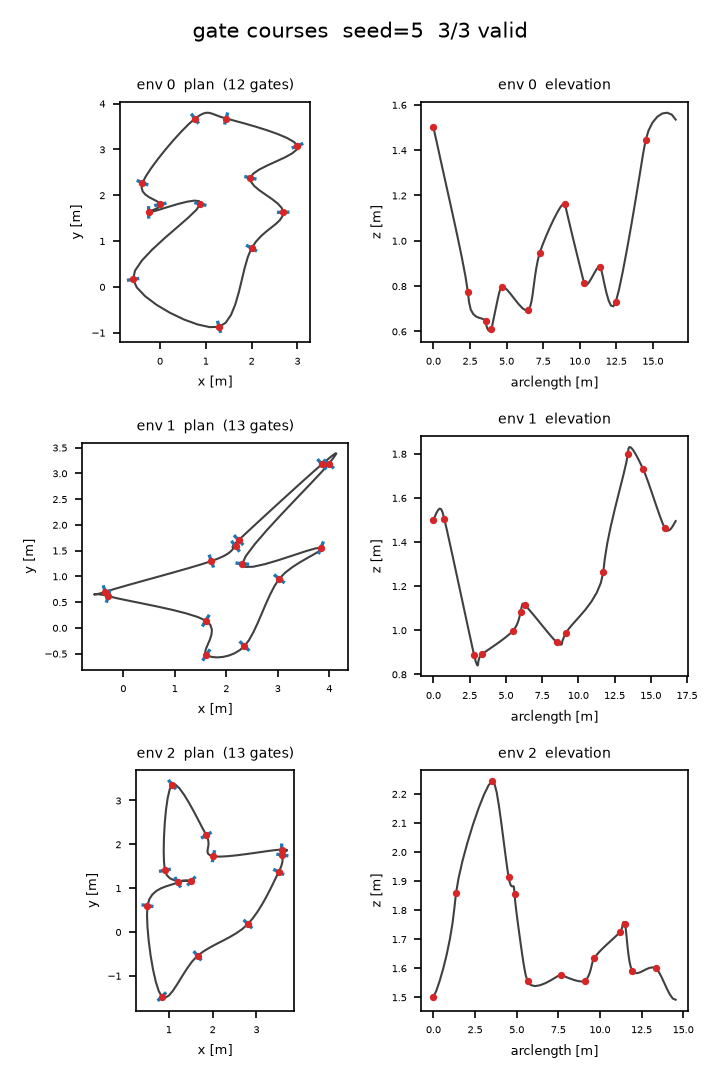
Three gate courses rendered by viz/plot_gate_courses.py (z_profile="random_walk",
gate_align="full_tangent"). Each env is drawn as a plan view (XY centerline plus
per-gate left/right bars) and an elevation profile (arc length vs. z), with the closed
CourseLine spline threading the gates. Regenerate with
python viz/plot_gate_courses.py --out docs/_static/gate-courses.png --envs 3 --seed 5.
Gate alignment: gate_align
Once each gate has an altitude, its frame (the roll-free orientation quaternion, with
local x = gate forward, y = left, z = up) is built from the tangent. gate_align
chooses which tangent:
"yaw_only"(default) uses the plan-view tangent — the 3D tangent projected onto the XY plane. The gate posts stay horizontal, so a gate’sleftandrightendpoints share the center’s altitude. This is the natural choice for drone gates that hang level regardless of the course slope."full_tangent"aligns the frame forward axis with the full 3D tangent, tilting the posts to follow the course’s climb or descent. Use it when the gate plane should be perpendicular to the actual flight direction.
Either way the frame is roll-free (the up axis is kept as close to world-up as the
forward axis allows), and orientation is what the runtime, the collision frames, and
downstream consumers read — the removed normal field is recovered as
wp.quat_rotate(orientation, wp.vec3f(0, 1, 0)) when a left-axis vector is needed.
Runtime parity
A gates-mode Course drives these 3D courses exactly like track mode — construct → bind → generate → step / reset — with three additions that make the third dimension first-class:
Pass detection
Progress is a swept-segment plane-crossing test: between two steps the agent’s motion
segment is tested against the target gate’s plane, and a pass is counted only when the
crossing falls inside the opening — within the left-right extent and vertically within
the gate’s half-opening (CheckpointSet.up_half, aliased from GateSequence.half_size).
Because track cross-sections use an effectively unbounded vertical half-opening, planar
motion behaves exactly as before; a gate course, by contrast, will not credit a pass for a
drone that flies over or under the gate. res.events still exposes passed,
dist_to_next, and progress for reward shaping.
Pass detection uses the gate’s physical plane — the pose forward — in both alignment
modes, so a yaw_only gate on a sloped course is crossed exactly where its upright frame
stands.
The track frame
In gates mode course.step() returns a StepResult whose third field, res.frame,
is a TrackFrame localizing the agent on a closed 3D
CourseLine spline (a periodic Catmull-Rom curve through the gate centers). It carries
s (arc length along the spline), n (signed lateral offset, positive to the right
of travel), n_up (signed vertical offset in the roll-free frame at the foot point), and
segment (nearest spline segment). In track mode res.frame is None.
The centerline is sampled at samples_per_gate uniform spline-parameter steps per
gate segment — not constant 3D arc-length (samples bunch slightly where gates are close
together). arclen is nevertheless the true cumulative arc length of the sampled
polyline, so localization and progress are unaffected.
Frame collision
Beyond the post_radius gate-post discs, gates mode offers frame_collision=True:
each square gate becomes four thin oriented frame members and a FrameChecker tests the
agent sphere against them in the gate’s own 3D frame. It requires frame_thickness,
frame_depth, and agent_radius all > 0 and is mutually exclusive with
post_radius > 0 (choose discs or frames). The contact is a FrameContact
(hit, depth).
Validity
The 2D layout validity checks are unchanged: a sequence is rejected for the same planar
reasons as before (degenerate counts, crossing gate bars under a positive gate_width,
and so on). The 3D pipeline adds one altitude check:
z_valid_grade— the maximum allowed|dz|/dsgrade between adjacent gates (ds= plan-view distance). A sequence with any adjacent pair steeper than this is marked invalid.z_valid_grade = 0(the default) disables the check.
Two v1 limitations are explicit by design:
Plan-view self-crossings. The track pipeline still rejects plan-view crossings, but a gate course may self-cross in XY on purpose — a stacked over/under section is a legitimate 3D course whose plan view crosses itself. Gate validity therefore does not reject XY crossings.
Spline XY drift is unchecked. Validity is evaluated on the gate anchors, not on the
CourseLinespline that interpolates them. The Catmull-Rom curve can bow away from the straight anchor-to-anchor chords, and that drift is not checked against the layout — keep gate spacing sane if you rely on the spline staying near the anchors.
Migration from the 2D API
The 3D data model is a breaking change relative to the pre-3D gate/track API. Verbatim from the commit that introduced it:
Breaking changes
GateSequence/Track geometry is vec3f; GateSequence.normal removed,
orientation (quatf) + half_size added; CheckpointSet gains up_half;
TrackFrame gains n_up; bound position buffers are [E] vec3f;
Course.bind takes orientation quaternions instead of yaw. XY behavior is
golden-verified bit-identical.
In practice:
Reshape geometry arrays with a trailing
3instead of2:wp.to_torch(gates.position).view(E, G, 3)(likewiseTrack.center/outer/inner). Thezcomponent is 0 for the planar track pipeline and carries real altitude for gate courses.Replace
GateSequence.normalreads withorientation(aquatfpose) plushalf_size; recover the old left-normal aswp.quat_rotate(orientation, wp.vec3f(0, 1, 0)).Bind
vec3fposition buffers and passCourse.bind(position=..., orientation=..., half_extents=...)with an[E * max_boxes]quatforientation buffer (identity quaternion(0, 0, 0, 1)if you have no rotation) instead of ayawfloat array.
See also
Generating Gate Sequences for Drone Courses — the end-to-end gate-generation recipe and output fields, including the RL runtime loop.
Gate relaxation — collision solve — the plan-view gate self-collision solve that runs before the Z profile.
The Course facade — the
Coursefacade that turns gates into checkpoints, the 3D localizer, and optional post/frame collision.