Track relaxation — the solver
This page covers how the fixed-iteration solve executes: the Jacobi double-buffering that keeps it graph-capturable, the two separation execution modes, and the Chebyshev semi-iterative acceleration that is the substance of the recent update. The constraints themselves — separation, spacing, bending — are described in Track relaxation — setup and constraints.
Jacobi semantics via double buffering
Every sweep reads one complete position buffer and writes updated positions into a second buffer, then the two buffers are swapped. A bead’s correction is computed from its neighbours’ previous-sweep positions, never from positions already updated within the same sweep. That is Jacobi iteration (as opposed to Gauss-Seidel, which would consume in-place updates as it goes).
Jacobi is the right choice here for two reasons:
GPU parallelism. Every bead’s update is independent within a sweep, so the whole batch of
E * N_maxbeads is one flat kernel launch with no ordering constraints and no atomics on the position buffers.Graph capture. The launch sequence is fixed and data-independent (a known number of sweeps, each a fixed set of launches), so the entire solve captures once into a replayable CUDA graph and replays with zero per-call allocation. Gauss-Seidel’s sequential dependence would serialize the beads and break the clean capture.
xpbd_solve_inplace copies the input centerline into relaxed (x_cur), uses
xpbd_db as the second buffer (x_hat), and ping-pongs the two across sweeps. Both
buffers are pre-allocated in RelaxScratch by the caller.
Separation execution modes
The non-local separation scan is the dominant cost — it is \(O(\text{count}[e]^2)\)
per track when run densely. Two modes trade exactness against cost, selected by the
relax_sep_* knobs.
Dense / cadenced mode
_step_kernel scans all non-band neighbours whenever step_i % relax_sep_every == 0;
spacing and bending still run every sweep. With relax_sep_cache_slots == 0 and
relax_sep_every > 1, this is a naive skip cadence: there is simply no separation
force between dense scans.
Broadphase-cached mode
When relax_sep_cache_slots > 0 and relax_sep_every > 1,
_build_sep_cache_kernel refreshes a fixed-slot directed candidate list every
relax_sep_every sweeps using radius target * (1 + relax_sep_cache_skin). Then
_step_cached_kernel runs every sweep, re-testing each cached candidate with the
exact current dist < target narrowphase before applying the separation push. The
cache arrays live in RelaxScratch, including an overflow counter for beads whose
candidate list exceeded the configured slot count, so the mode stays allocation-free and
CUDA-graph-capturable.
The default config uses the cached mode (relax_sep_cache_slots=16,
relax_sep_every=20, relax_sep_cache_skin=0.5). See Track relaxation — convergence and tuning for the
relax_sep_every short-run refresh pitfall.
Chebyshev acceleration
The plain Jacobi sweeps can be accelerated with the Chebyshev semi-iterative method,
selected by relax_accel="chebyshev" (the default). This is the precedent from Macklin
et al., “Unified Particle Physics for Real-Time Applications” (2014), applied to
position-based-dynamics Jacobi. It cuts the sweeps needed for a given yield by roughly 3x
(see Track relaxation — convergence and tuning).
Warmup, then blend
The first relax_cheby_start (default 8) sweeps run plain Jacobi, so the
separation contact set settles before acceleration engages. From then on, each sweep
runs the ordinary Jacobi step and then launches a small blend kernel
(_accel_blend_kernel) that combines the fresh Jacobi update with the current and
previous iterates:
where \(\hat{x}\) is the Jacobi output for this sweep, \(\gamma\) =
relax_cheby_gamma (default 0.9) is a constant under-relaxation factor, and
\(\omega_k\) is the per-sweep Chebyshev weight from a host-precomputed recurrence:
with \(\rho\) = relax_cheby_rho (default 0.98) the spectral-radius estimate of
the Jacobi iteration. The \(\gamma < 1\) under-relaxation damps the contact-switching
noise that raw acceleration would otherwise amplify on the nonsmooth separation contacts.
The warmup sweeps skip the blend launch entirely rather than blending with \(\omega = 1\): an \(\omega = 1\) “identity” blend is not bit-exact in float arithmetic, and skipping it also saves launches.
Three-buffer rotation and the transition trick
Acceleration needs a third buffer for the previous iterate \(x_{\text{prev}}\)
(cheb_prev in RelaxScratch). Once engaged, the three buffers rotate each sweep:
the blended output becomes the next x_cur, the old x_cur becomes the next
x_prev, and the freed buffer becomes the next sweep’s Jacobi output — fully
overwritten by the step kernel before the blend reads it.
The subtle part is the very first accelerated sweep. There is no true previous iterate
yet, so the caller passes x_prev aliasing x_cur. Then
\((x_{\text{cur}} - x_{\text{prev}})\) cancels exactly and \(\omega = 1\) there,
making the result independent of the third buffer’s contents. As a consequence
cheb_prev is never read before being written within a solve — its initial
contents are irrelevant, so there is no zero-init and the solve is safe under CUDA graph
replay (where buffer contents persist between replays).
Graph-capture and zero-alloc
The \(\omega\) schedule is precomputed on the host and is data-independent, so
the accelerated solve is still a fixed launch sequence with no host sync or
data-dependent branching inside the loop. The whole solve remains CUDA-graph-capturable
and zero-alloc per call: cheb_prev is pre-allocated in RelaxScratch (the capture
path requires it; outside capture a missing buffer is allocated as a convenience for
tests).
Setting relax_accel="none" restores plain damped Jacobi wholesale — no blend kernel,
no third buffer, the legacy two-buffer ping-pong.
Smoothing tail
After the main sweep loop, an optional post-solve smoothing tail runs. It removes the fine curvature noise the three constraints leave behind: the bending guard only fires when the local radius drops below \(R_{\min}\) (a deadband), so gentler sub-\(R_{\min}\) wiggles — small kinks that survive separation and spacing — are invisible to all three constraints and never get smoothed by the main solve.
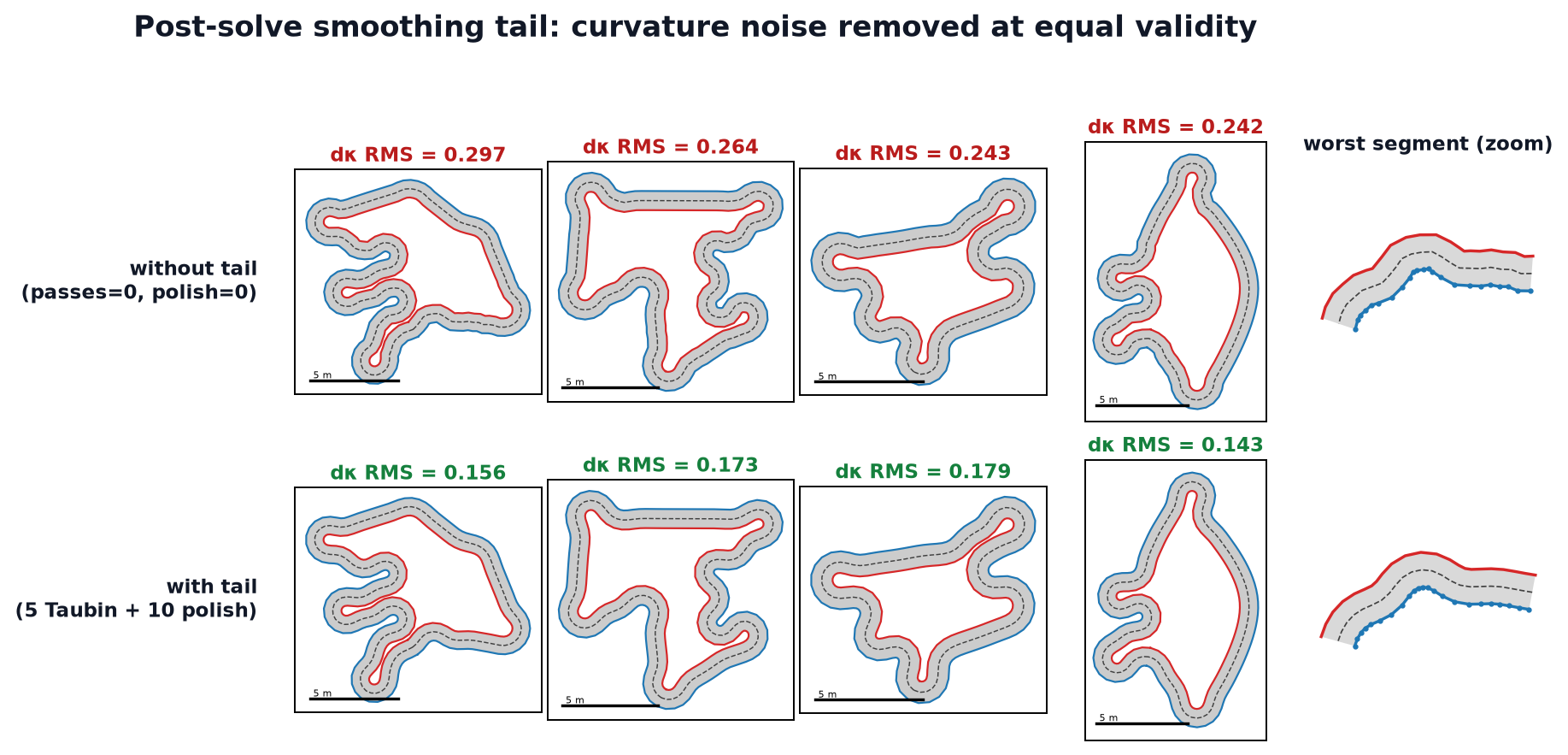
The four noisiest valid tracks (metric benchmark regime, identical seeds) without the tail (top) and with the default tail (bottom); the per-panel number is the curvature-noise metric (dkappa RMS — RMS of adjacent Menger-curvature differences, scaled by half-width). The 5th column zooms the most rippled border segment of the worst track: the sub-\(R_{\min}\) wiggle on the outer border (top) is gone after the tail (bottom). Across the full benchmark (E=4096) the default tail cuts curvature noise by −30% / −34% (hard / defaults regime) with zero yield loss and a slightly improved spacing RMS.
Taubin, not Laplacian
The tail uses Taubin smoothing — shrink-free Laplacian smoothing. One pass is two Laplacian half-steps over the circular bead chain:
with \(\lambda = 0.5\) (a positive shrinking step) and \(\mu = -0.53\) (a slightly larger negative un-shrinking step). Because \(\mu < -\lambda\), the two half-steps cancel the low-frequency shrink while still attenuating high-frequency noise — the pass smooths without pulling the curve inward. This matters for validity: a plain Laplacian (\(\mu = 0\)) shrinks corners, dragging them back through the thickness gate — in the prototype 10 plain-Laplacian passes collapsed yield to 0.12. The \(\lambda\)/\(\mu\) constants are hardcoded (not config); only the pass counts are exposed.
Two knobs
relax_smooth_passes(default 5) — number of Taubin passes (each two half-steps).relax_smooth_spacing_iters(default 10) — spacing-only polish sweeps applied after the Taubin passes (the ordinary edge-spacing correction with separation and bending off), which restore the bead uniformity the Taubin passes perturb.
Setting both to 0 disables the tail. In the prototype the default tail cut curvature-difference RMS ~33% on average (~51% on the worst track) with zero validity loss and slightly improved spacing RMS.
Graph-capture and zero-alloc
The tail simply continues the read/write ping-pong from wherever the main loop left it
(the Chebyshev previous-iterate buffer is not used). Its launch sequence is a fixed,
data-independent function of the two pass counts, with no per-call allocation, so it stays
CUDA-graph-capturable exactly like the main solve. The Taubin passes reuse a small
count-aware kernel (_taubin_kernel, NaN-preserving on padding beads); the spacing
polish reuses the main _step_kernel with separation and bending switched off.