Generating Gate Sequences for Drone Courses
For drone-style courses where road width is irrelevant, track_gen provides
GateGenerator. It emits gate centers and orientations directly from the
centerline-generator anchors and skips constant-spacing resampling, XPBD
relaxation, and inflation — making it faster than the full track pipeline.
See also
Gate courses are 2.5D: this tutorial covers the plan-view layout and the runtime
loop, while 3D gate courses covers altitude — the four z_profile families, the
gate_align modes, the 3D localizer, and frame collision.
Prerequisites
Install track_gen with the dev extra:
uv pip install -e ".[dev]"
Building the Gate Config
GateGenConfig controls every gate-generation parameter. The key fields are
generator (which centerline generator to use), gate_ordering,
num_envs, max_gates, gate_width, gate_radius, and
gate_solve_iters.
import warp as wp
wp.init()

from track_gen import GateGenConfig, GateGenerator, PerEnvSeededRNG

E, device = 64, "cuda"
config = GateGenConfig(
    generator="bezier",
    gate_ordering="random_pairs",
    num_envs=E,
    max_gates=32,
    gate_width=0.4,
    gate_radius=0.025,
    gate_solve_iters=8,
    device=device,
)
rng = PerEnvSeededRNG(seeds=0, num_envs=E, device=device)
Generating the Gate Sequence
gates = GateGenerator(config, rng).generate()

position = wp.to_torch(gates.position).view(E, config.max_gates, 3)
tangent  = wp.to_torch(gates.tangent).view(E, config.max_gates, 3)
valid    = wp.to_torch(gates.valid).bool()
GateGenerator pre-allocates all buffers in __init__, exactly like
TrackGenerator. On cuda, the first generate() captures the pipeline
into a wp.Graph; subsequent calls replay it with updated seeds.
Reading the Output Fields
Field |
Shape |
Meaning |
|---|---|---|
|
|
|
|
|
|
|
|
Roll-free gate pose |
|
|
Square-opening half-extent ( |
|
|
|
|
|
Per-sequence validity. A positive |
|
|
Real gates per environment. Slots at index |
Slicing Real Gates
Like Track, the GateSequence arrays are NaN-padded past each
environment’s real gate count. Use count to slice valid gates:
count = wp.to_torch(gates.count)

n0 = int(count[0])
pos_env0  = position[0, :n0]   # real gate centers for env 0
tan_env0  = tangent[0,  :n0]   # real gate tangents for env 0
Gate Figure
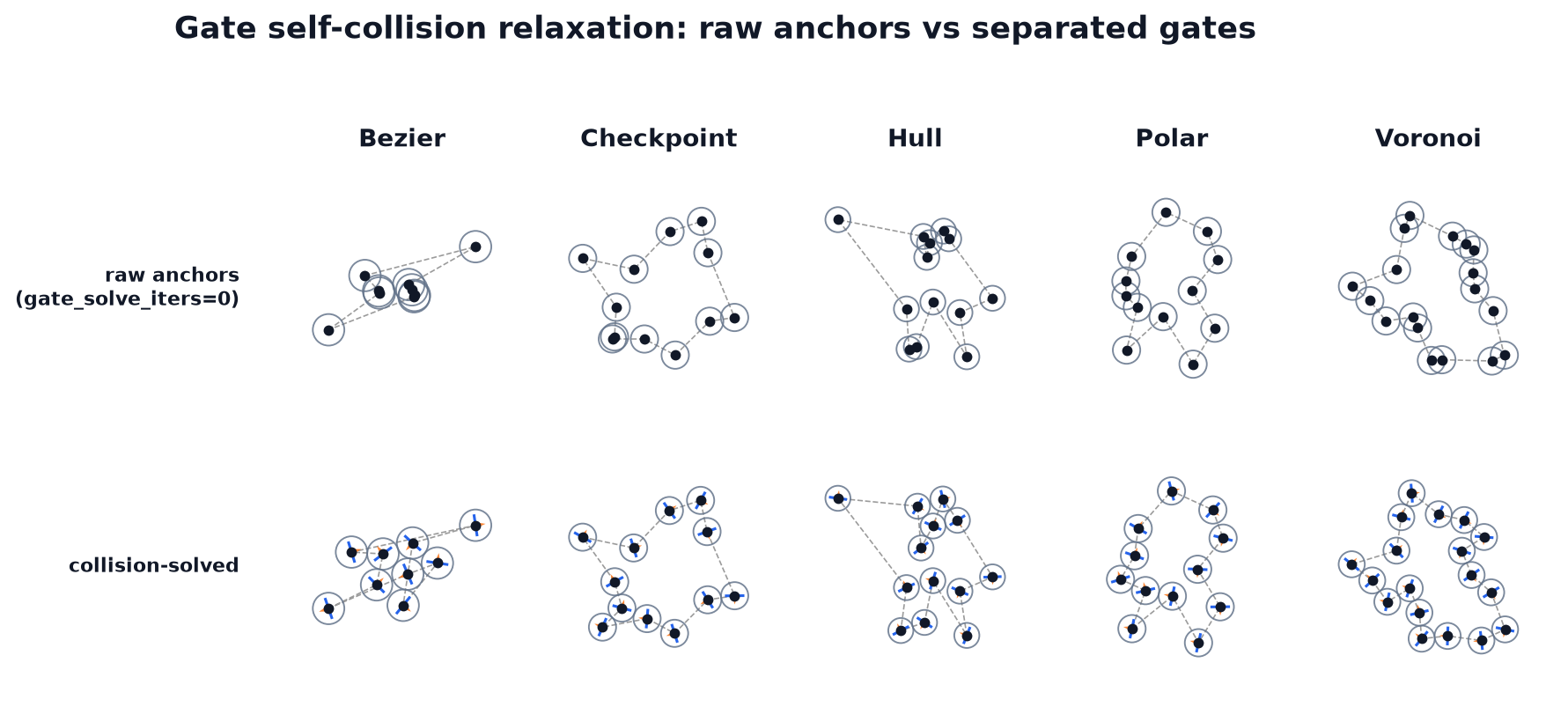
Gate self-collision relaxation. Top: raw anchors (gate_solve_iters=0);
bottom: after the solve, with gate tangents and gate_width bars.
Gate Ordering per Generator
The ordering of gates in the output sequence is controlled by
GateGenConfig(gate_ordering=...). Not all orderings are supported by every
generator:
Generator |
Supported orderings |
|---|---|
|
|
|
|
|
|
|
|
|
|
Note
The "ccw" ordering name is kept for API compatibility. Its current
centroid-angle convention is clockwise in standard xy coordinates.
The gate_solve_iters Collision Behavior
Gate centers are treated as disks with radius gate_radius. The center
spacing target between adjacent gates is 2 * gate_radius. Setting
gate_solve_iters > 0 runs up to that many iterations of a deterministic
pairwise push that separates overlapping gate disks before recomputing tangents.
Set gate_solve_iters=0 to inspect the raw anchors before the collision
solve. The anchors are still ordered and bounding-box normalized — they are just
not spread apart yet, so close gates may overlap.
When gate_solve_iters > 0, the collision solve may expand the final bounding
box when necessary to satisfy the requested gate_radius. A positive
gate_width causes any sequence whose gate bars still cross after the solve to
be marked invalid.
See also
Gate relaxation — collision solve documents the gate collision solve in depth — the sphere
model and 2 * gate_radius target, the per-env Gauss-Seidel semantics, the
determinism of the coincident-gate tie-break, and its behaviour under graph capture.
Note
max_gates must be at least the chosen generator’s reachable gate count.
min_gates rejects a config that the generator cannot satisfy. Both bounds
are checked at GateGenerator construction time.
Buffer Reuse and Snapshots
The same GateSequence instance and its underlying Warp buffers are reused on
every generate() call. For an independent snapshot use gates.clone():
snapshot = gates.clone() # independent copy; safe to keep across generate()
Flying Through the Gates: Progress and Post Collision for RL
Generation gives you the gate geometry; an RL or controller loop also needs to know, each step, did the drone just clear the next gate? and did it clip a gate post? The Course facade bundles gate generation with the checkpoint/progress tracker and an optional gate-post collision checker in one object, so you never wire those together by hand. Its lifecycle is construct → bind → generate → step / reset — identical to track mode, only the config and the contact type differ.
In mode="gates" the gates themselves become the checkpoints
(CheckpointSet.from_gates → ProgressTracker), so there is no
checkpoint_spacing — passing it is rejected, as is the track-mode
collision= option. Gate-post collision is opt-in via post_radius > 0: a
DiscChecker over the gate-bar endpoints (left/right), with the posts
array rebuilt device-side on every regeneration. It requires gate_width > 0
(a width-0 gate has no bar and no posts to hit).
Build a Course in gates mode, bind the sim’s own state buffers (they are
read in place every step), generate the batch, then in the step loop read
the progress events for gate rewards and contacts (a DiscContact
here) for a post-collision penalty:
import numpy as np
import warp as wp
wp.init()

from track_gen import GateGenConfig
from track_gen.course import Course, CourseConfig

E, device = 4, "cpu"

course = Course(CourseConfig(
    mode="gates",
    gen=GateGenConfig(num_envs=E, gate_width=0.4, gate_radius=0.025,
                      max_gates=32, device=device),
    seeds=7,
    post_radius=0.03,          # > 0 enables DiscChecker gate-post collision;
                               # 0 (default) = progress-only. No collision= /
                               # checkpoint_spacing here — those are track-mode.
))

# Bind the sim's own buffers: position (vec3f) drives gate progress;
# orientation (quatf) + half_extents (vec2f) are the oriented box tested
# against the posts. The sim writes these in place each step. (With
# post_radius == 0, bind position alone.)
position     = wp.zeros(E, dtype=wp.vec3f, device=device)
orientation  = wp.array(np.tile([0.0, 0.0, 0.0, 1.0], (E, 1)).astype(np.float32),
                        dtype=wp.quatf, device=device)   # identity quats
half_extents = wp.array(np.full((E, 2), 0.01, np.float32),
                        dtype=wp.vec2f, device=device)
course.bind(position=position, orientation=orientation, half_extents=half_extents)

seq = course.generate()        # whole batch + posts rebuild + progress reset

for step in range(40):
    # sim.step() writes `position` (and `orientation`) in place here.

    res    = course.step()                     # events + contacts, no args
    passed = res.events.passed.numpy()         # [E] int32: cleared a gate this step
    dist   = res.events.dist_to_next.numpy()   # [E] float32: distance to next gate
    hit    = res.contacts.hit.numpy()          # [E] int32: 1 == box touched a post
    disc   = res.contacts.disc.numpy()         # [E] int32: deepest post, -1 == none

    reward = 10.0 * passed - 5.0 * hit         # gate bonus, post penalty (shaping)

# Per-env respawn on the SAME course: clear progress only where mask[e] == 1.
done = np.zeros(E, np.int32)
done[0] = 1
course.reset(wp.array(done, dtype=wp.int32, device=device))

# New courses for everyone: whole-batch regenerate + full progress reset.
# The posts are rebuilt device-side onto the new gates automatically.
course.generate(seeds=123)
res.events gives the progress signals — passed for a gate-clear bonus,
dist_to_next for a negative-delta-distance shaping term, and progress
for the total gates cleared since the last reset (next_checkpoint is the
current target gate). res.contacts is a
DiscContact (not the BoxContact of track mode):
hit is the reward/termination signal, disc the deepest-penetrating post
(gate = disc // 2 since posts interleave left/right), and depth /
nearest drive a contact response. With post_radius == 0 the course is
progress-only and res.contacts is None.
Post collision backend
Gates mode has no out-of-bounds band — there is nothing to leave — so the only
collision is the optional gate posts. post_radius > 0 builds a
DiscChecker over the interleaved left/right bar endpoints; NaN
padding past each env’s real gate count carries over and NaN posts are skipped,
so no per-env count bookkeeping is needed. See
Out-of-bounds & obstacle collision for the disc-obstacle checker (the same one makes
cones physical) and Checkpoints & progress for the checkpoint/reward
contract that gates reuse.
CUDA-graph composability
step() and reset() are warp-native and capture-ready: flip the single
shared capture flag with track_gen.set_capturing(True) and the whole step —
gate progress update plus post-collision query — records into your own sim graph
alongside the physics. Keep writing into the SAME bound buffers after capture
(rebinding leaves the captured graph reading the old pointers). See
Integrating the CUDA Graph into a Batched RL Sim Loop for the capture-and-replay pattern.
Full Example
import warp as wp
wp.init()

from track_gen import GateGenConfig, GateGenerator, PerEnvSeededRNG

E, device = 64, "cuda"
config = GateGenConfig(
    generator="bezier",
    gate_ordering="random_pairs",
    num_envs=E,
    max_gates=32,
    gate_width=0.4,
    gate_radius=0.025,
    gate_solve_iters=8,
    device=device,
)
rng   = PerEnvSeededRNG(seeds=0, num_envs=E, device=device)
gates = GateGenerator(config, rng).generate()

position = wp.to_torch(gates.position).view(E, config.max_gates, 3)
tangent  = wp.to_torch(gates.tangent).view(E, config.max_gates, 3)
left     = wp.to_torch(gates.left).view(E, config.max_gates, 3)
right    = wp.to_torch(gates.right).view(E, config.max_gates, 3)
valid    = wp.to_torch(gates.valid).bool()
count    = wp.to_torch(gates.count)

n0 = int(count[0])
print(f"env 0: {n0} gates, valid={bool(valid[0])}")
print("gate centers:", position[0, :n0])