Generators Overview
track_gen ships six registered centerline generators.
Each generator is pluggable through TrackGenConfig.generator and follows the same
pipeline contract: it writes one closed centerline per environment, then the shared
resample → XPBD relax → inflate → validity stages take over — except repulsive, which
is not CUDA-graph-capturable (see below).
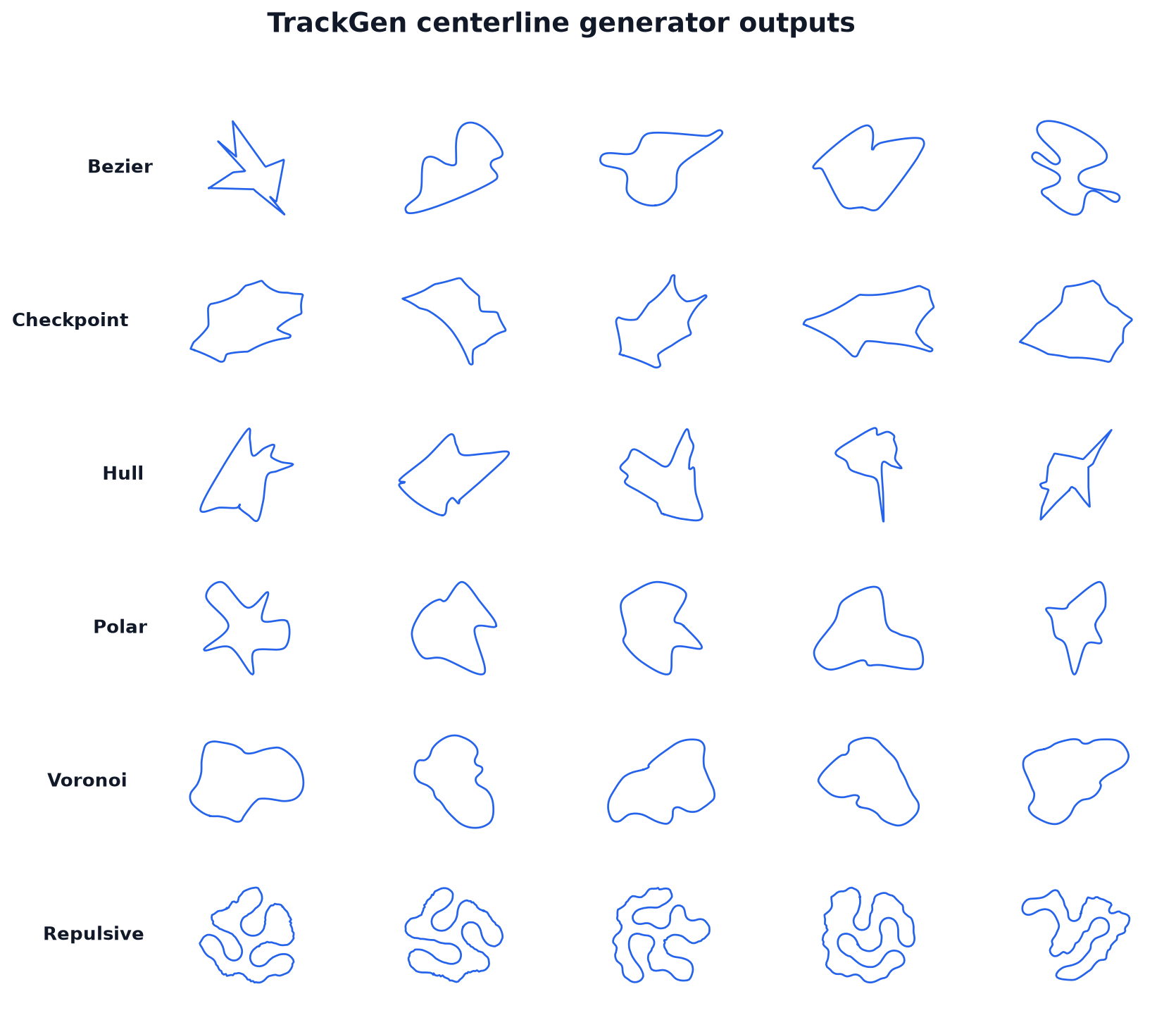
Sample tracks from the six generators (one row per generator).
The Six Generators
bezier
Samples random grid-jittered corners, sorts them by angle around their centroid,
and assembles a closed cubic Bézier spline. Handle lengths are proportional to
rad * chord and clamped by handle_clamp_frac so handles cannot overshoot
nearby corners. Optional style_sampling draws per-environment rad,
scale, and handle_clamp_frac from configured ranges, broadening the shape
family without changing the representation. Self-crossing smooth curves fall back
to their provably simple corner polygon, which XPBD re-rounds.
See Bezier Generator for the full deep dive.
hull
Angle-sorts a set of randomly sampled points around their centroid — a static
stand-in for a convex hull — then interleaves each adjacent pair of sorted vertices
with one radially displaced midpoint. The augmented loop is smoothed by a closed
uniform Catmull-Rom spline. hull_displacement controls how strongly midpoints
are pushed outward (lobes) or inward (pinches and straights). Catmull-Rom
self-crossers fall back to an arc-resampled straight augmented polygon.
See Hull Generator for the full deep dive.
polar
Builds polar_num_knots control knots in polar coordinates: each knot starts at
an evenly spaced angle, receives bounded angular and radial jitter, and the resulting
sequence is smoothed by a closed uniform Catmull-Rom spline. The output is
bounding-box normalized to the shared target extent. Because the shape is smooth
and centered by construction, polar carries the lowest relaxation burden of the five
generators and has no generator-local fallback.
See Polar Generator for the full deep dive.
voronoi
Draws a fixed site field under one of four layouts (ring, void_ring,
clustered, mixed) and selects voronoi_control_points anchor sites by
snapping angular sector targets — jittered by voronoi_angular_jitter with radius
modulated by voronoi_radial_variation — to the nearest unused site. The anchor
cycle is rounded by one Chaikin subdivision and a closed Catmull-Rom pass, then
arc-resampled. Self-crossing smooth loops fall back to the selected anchor polygon.
The void_ring default produces the highest compactness of the five generators.
See Voronoi Generator for the full deep dive.
checkpoint
Steers a bounded-turn path through checkpoint_count radial checkpoints drawn at
uniformly spaced angles with bounded jitter, producing an organic, continuously
undulating loop unlike the star-shaped families. A fixed num_points-step walk
with heading gain checkpoint_steer_gain and per-step turn clamp
checkpoint_turn_rate replaces CarRacing’s unbounded retry loop. An additive
heading-ramp closure ensures the net turning number is exactly one (no inner loops)
while preserving the steered local curvature. Best-of-K selection (default K=4)
keeps the least-self-intersecting of K decorrelated candidates per environment;
an optional single-crossing clip fallback is available but off by default.
See Checkpoint Generator for the full deep dive.
repulsive
Grows each centerline from a small seed circle under a hard ratcheting length constraint,
using a tangent-point energy and a Sobolev-preconditioned flow to keep the curve
self-avoiding while it is confined to a disc domain seeded with random obstacles —
coarse-to-fine (N = 64 → 128 → 256) with an area-based stall-stop. It is the only
generator built from iterative physical simulation rather than a single deterministic
sampling + smoothing pass, and produces the foldiest, most serpentine circuits of the six
(compactness ≈ 0.15). It is also the first generator that is not CUDA-graph-capturable
(capturable=False): its host-side stage transitions and stall-stop readback are illegal
inside a capture region, so it runs eagerly on CUDA every call —
roughly 1000× slower than bezier (~0.2 s @ E=64, ~5 s @ E=8192 on an RTX 4090).
Prefer a slow regeneration cadence or staggered per-env slices over calling generate()
every step. See Repulsive Generator for the full deep dive.
When to Use Which
Generator |
Shape character |
Typical compactness |
Best suited for |
|---|---|---|---|
|
Star-shaped corner families; smooth cubic curves |
Low (~0.44) |
General-purpose diversity; most configurable style knobs |
|
Angle-sorted loop with radial lobes and pinches |
Low (~0.43) |
Tracks with pronounced lobes, pinches, or straight sections |
|
Smooth periodic radial spline; centered by construction |
Medium (~0.56) |
Low-burden contrast to corner families; fast, symmetric shapes |
|
Graph-cycle anchored to a site field; compact and feature-rich |
High (~0.73) |
Complex, compact layouts; largest lap-time variety |
|
Flowing organic loop from bounded-turn steering |
Medium-high (~0.61) |
Organic circuit feel; CarRacing-style continuously curving tracks |
|
Dense, foldy serpentine from self-repulsive growth |
Very high (~0.15) |
Maze-like circuits; only when the ~1000× generation cost (non-graph-captured, see Repulsive Generator) fits your regeneration cadence |
Generator Contract
A generator produces the initial closed centerline fed to the shared pipeline.
It implements two callables: alloc_scratch(config) allocates fixed-shape,
generator-private Warp buffers once at construction time, and
generate(seeds_wp, config, out_centerline, out_valid_wp, scratch) writes one
closed centerline per environment into the orchestrator-owned output buffer in place.
The hot path must be pure Warp and deterministic in (seed, config). For the five
capturable=True generators it must additionally be zero-allocation inside generate
and CUDA-graph-capturable — no host-side retry loop, no host branch on generated tensor
data, and no per-environment Python branching inside generate. A generator may instead
declare capturable=False (currently only repulsive) to use host-side control flow
and per-call allocation; it then runs eagerly on CUDA every call instead of being captured
into a replayable graph. Generators set out_valid_wp to 1 for every environment at
this stage; final geometric validity (turning number, thickness, NaN checks) is decided
later by the shared post-relax inflation validity gate. The full contract, hard rules, and
registration instructions are documented in Writing a Generator.
Benchmarks
The generation cost of each centerline generator is summarized below; a companion
shape/geometry-metrics comparison table will follow later (the full quality/diversity
metric suite already lives in Generator Benchmarks). All rows were measured on an
NVIDIA RTX 5000 Ada at num_envs = 4096 with the library-default
TrackGenConfig (half_width = 0.1, num_points = 256, relax_iters = 50),
timing the full TrackGenerator.generate() call — centerline generation plus the
shared resample → XPBD relax → inflate stages — since only the centerline generator
differs across rows. warmed ms/call is the steady-state mean over 10 replays after a
warmup call; for the five capturable generators this is a CUDA-graph replay. first
call (s) is that warmup call, which pays CUDA-graph capture plus cached Warp module
load. Each row was measured twice and agreed within ~10%.
Generator |
warmed ms/call |
first call (s) |
yield |
|---|---|---|---|
|
10.1 |
0.05 |
0.998 |
|
11.1 |
0.05 |
0.992 |
|
7.7 |
0.04 |
1.000 |
|
13.9 |
0.06 |
1.000 |
|
13.7 |
0.06 |
0.995 |
|
~1880 |
~1.9 |
0.997 |
The first call (s) figures above are taken with Warp’s on-disk kernel cache warm (capture plus cached module load only); the very first run after a fresh install or a kernel-source change additionally pays a one-time ~4 s Warp JIT compilation that is shared across all generators.
To reproduce per-generator timing at this scale, use
benchmarks/compare_generators.py (its gen_ms_per_call column is the warmed
steady-state generation time):
.venv/bin/python -m benchmarks.compare_generators --cuda --E 4096