Hull Generator
The hull generator produces closed track centerlines in the angle-sorted-loop-with-lobes
family. It samples a set of random grid-jittered points, orders them by centroid-relative
angle as a cheap static stand-in for a convex hull, interleaves each edge with one
radially displaced midpoint to introduce lobes and pinches, and then smooths the augmented
loop with a closed uniform Catmull-Rom spline. The key identity of the method is
the midpoint-displacement layer: without it the output would collapse toward a plain
angle-sorted polygon; with it the generator produces the pronounced lobes, tight pinches,
and extended straights that give racing tracks their character.
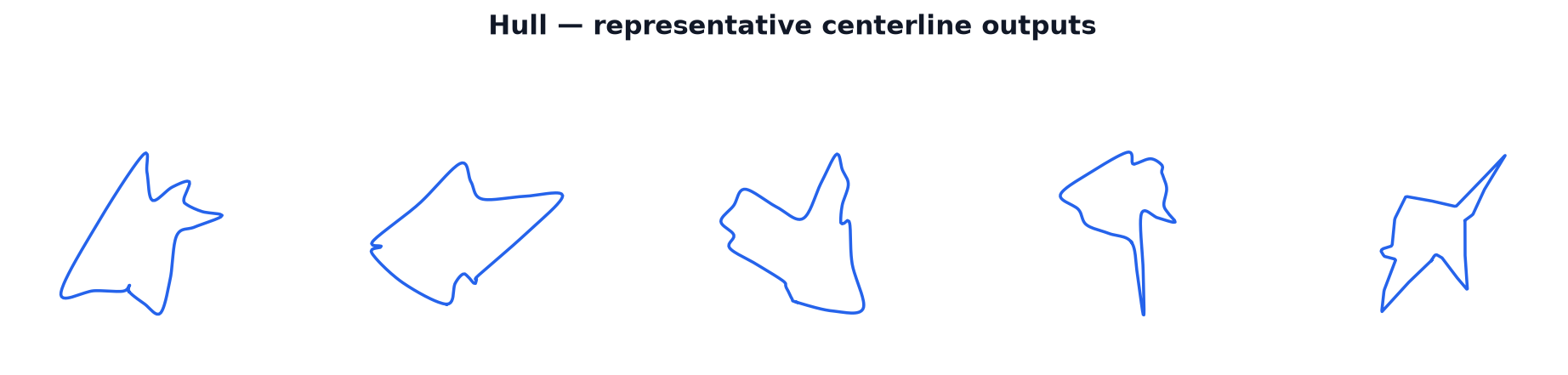
Representative centerlines produced by the hull generator at the default configuration. Note the mix of outward lobes, inward pinches, and near-straight sections created by the midpoint displacement layer.
How It Works
The hull generator executes a fixed sequence of pure-Warp GPU kernels with no per-call allocation and no host-side branching on generated data, making it CUDA-graph-capturable.
Point count and position sampling.
_point_count_sample_kdraws a per-environment point countmfrom the uniform integer range[min_num_points, max_num_points]using RNG salt5119._point_sample_kthen drawsP = max_num_pointsgrid-jittered points per environment from anum_cells x num_cellsgrid with bounded duplicate-cell rejection (up to eight retries per point). The cell size ismin_point_distance * 2; each accepted cell receives a sub-cell jitter ofU(-0.5, 0.5)in each axis before being multiplied byscale. RNG salt7919is distinct from the Bezier generator’s9781so the two generators draw different point sets even at the same seed.Angle-sort (hull-like ordering).
_angle_sort_kcomputes the centroid of the firstmpoints and sorts them ascending byatan2(dx, dy)(x-first convention, matching the Bezier ccw-sort) around that centroid. Entries beyond indexmare written as NaN. This is an insertion sort over a fixedP-length window, so the kernel is single-threaded per environment and runs in bounded time. The result is a simple closed base loop — not a true convex hull (which requires dynamic allocation), but a static, fixed-shape stand-in that gives a topologically simple ordered polygon.Midpoint-displacement layer.
_midpoint_displace_kinterleaves each adjacent pair of angle-sorted vertices with one displaced edge midpoint, producing an augmented loop of2mvertices:[v_0, mid_01', v_1, mid_12', v_2, ..., mid_(m-1,0)']
For each edge
(v_i, v_{i+1 mod m}), the geometric midpointM_iis computed and then displaced along the radial direction from the centroid throughM_iby a signed per-edge random amount. Positive values push the midpoint outward (lobe); negative values pull it inward (pinch or straight). Entries beyond index2mare written NaN and ignored by the arc-resampler downstream. The augmented-loop stride is2Pto match the fixed allocation.Closed Catmull-Rom smoothing.
_catmull_rom_kevaluates a closed uniform Catmull-Rom spline over the2maugmented vertices into a dense buffer of2P * num_points_per_segmentslots per environment. Each segment from vertexito vertexi+1is sampled atnum_points_per_segmentequally-spaced parameter valuesu = s / (npseg - 1). Segment indicesi >= 2m(beyond the real augmented count) write NaN and are skipped by the arc-resampler. Index wrap-around is handled by taking indices modulocnt = aug_count[e], ensuring the spline closes back to the first vertex.Arc-resample.
_arc_resample_inplace(shared with the Bezier generator) converts the dense Catmull-Rom polyline into exactlynum_pointsarc-length-uniform output points per environment by accumulating segment lengths, building a cumulative arc-length table, and interpolating.Fallback for self-crossers.
self_intersections_inplacecounts proper crossings in the smooth resampled loop. For environments where the smooth result self-crosses,_assemble_polygon_selected_kemits a straight piecewise-linear version of the augmented loop into the dense buffer (only for those rows), and_arc_resample_selected_inplaceoverwrites the corresponding output centerline rows in place. Non-crossing rows are never touched by the selected resampler. XPBD can re-round the straight polygonal fallback downstream.
Math
Closed uniform Catmull-Rom spline.
For segment i (from control vertex P_i to P_{i+1}), the spline is
evaluated at parameter u \in [0, 1) using the four surrounding control vertices
P_{i-1}, P_i, P_{i+1}, P_{i+2} (indices taken modulo the augmented
vertex count to close the loop):
Expanding the matrix product, the kernel evaluates:
This is the standard tension-0.5 uniform Catmull-Rom formulation: the spline passes
exactly through P_i at u = 0 and through P_{i+1} at u = 1, with
C1 continuity at every knot. The source (_catmull_rom_k) implements this
expression directly; the matrix form and the expanded scalar form are equivalent.
Midpoint radial displacement.
Let C be the centroid of the m angle-sorted vertices. For edge i,
let M_i = \tfrac{1}{2}(v_i + v_{i+1 \bmod m}) be the geometric midpoint and
let \(\hat{e}_i = (M_i - C) / \|M_i - C\|\) be the outward unit radial direction.
The displaced midpoint is:
where d = hull_displacement. The displacement magnitude therefore scales with
the centroid-to-midpoint distance, making the fractional perturbation relative to
local track radius uniform across edges regardless of the overall shape size.
Positive r_i bulges the lobe outward; negative r_i pinches it inward.
Note: The task brief describes the displacement range as simply
\([-d, +d]\) with d = hull_displacement. The source shows the range is
\([-d \cdot \|M_i - C\|,\; +d \cdot \|M_i - C\|]\) — i.e., scaled by the
centroid-to-midpoint distance. The source is authoritative.
Parameters
The following TrackGenConfig fields are consumed by the hull generator.
For the full parameter reference and default values, see the configuration
reference in docs/reference/.
min_num_pointsintMinimum number of base corner-anchor points per environment. Must be >= 2. Shared with the Bezier generator. Larger values guarantee more vertices in the base loop, producing more complex shapes even at small
hull_displacement.max_num_pointsintMaximum number of corner-anchor points. Also sets
P, the fixed allocation width. Must be >=min_num_points. A wider range adds per-environment diversity; the augmented loop has up to2 * max_num_pointsvertices.num_points_per_segmentintNumber of Catmull-Rom samples emitted per segment of the augmented loop before arc-resampling. Must be >= 2. Higher values give the arc-resampler a finer cumulative arc-length grid, reducing interpolation error in the final
num_points-point centerline.min_point_distancefloatMinimum grid-cell spacing for corner-position sampling. Must be in
(0, 0.5]. Controls the cell grid asnum_cells = int(1 / (min_point_distance * 2)). Smaller values allow more densely packed anchor points; larger values spread them further apart.scalefloatIsotropic scale multiplier applied to all sampled corner positions. Shared with the Bezier generator; scales the coordinate range seen by the downstream constant-spacing, XPBD-relax, and inflate stages.
hull_displacementfloatHull generator only. Maximum per-edge radial midpoint displacement expressed as a fraction of the centroid-to-midpoint distance (see Math above). Default
0.15. At0.0the midpoints remain on the edges and the method collapses toward a plain angle-sorted loop. Typical range[0.1, 0.4]; larger values produce stronger lobes, pinches, and straight sections at the cost of a higher downstream relaxation and thickness burden.
What Makes It Distinct
The hull generator occupies a different region of the shape space than the other four generators:
Versus bezier: Both generators sample grid-jittered corners and angle-sort them around a centroid. Bezier assembles a closed cubic Bézier spline through those corners with handle-length and edginess knobs; hull instead inserts displaced midpoints between every pair of sorted vertices and applies Catmull-Rom smoothing. The midpoint-displacement layer gives hull its distinctive lobed and pinched character at the cost of the fine curviness control that
rad,edgy, andhandle_clamp_fracprovide in bezier.Versus polar: Polar builds its shape in polar coordinates from the start, guaranteeing a smooth, centered, approximately star-shaped output with no local fallback needed. Hull is Cartesian and explicitly inserts non-convex features via displacement; it is not centered by construction and carries a higher relaxation burden than polar.
Versus voronoi: Voronoi selects anchor sites from a pre-sampled field under one of four layout modes and rounds the resulting cycle with Chaikin and Catmull-Rom. Hull is simpler (no site field, no layout modes) and its shape family is controlled by a single
hull_displacementscalar rather than by site-field topology.Versus checkpoint: Checkpoint steers a continuous path through radial checkpoints, producing an organic flowing loop with continuously varying curvature. Hull produces a star-shaped loop (around the corner centroid) with locally inserted features; the two generators produce qualitatively different shape classes.
Within the hull family: At
hull_displacement = 0, the output is nearly identical to a plain angle-sorted polygon smoothed by Catmull-Rom — essentially a smoother bezier withrad = 0. Increasinghull_displacementprogressively introduces lobes and pinches. Because the displacement direction is always radial, the overall topology stays star-shaped around the centroid; very large displacements can produce self-crossings that trigger the polygon fallback.
Fallback and Validity
The hull generator has a local per-environment polygon fallback for the self-crossing
case. After the smooth Catmull-Rom centerline is arc-resampled, its self-intersections
are counted. Any environment whose smooth result self-crosses has its output
overwritten in place by the arc-resampled straight augmented polygon — the
2m-vertex piecewise-linear loop of original corners interleaved with displaced
midpoints, without Catmull-Rom smoothing. This fallback is provably simple if the
displacement is small enough that the midpoints do not cross each other; XPBD
re-rounds the polygonal fallback in the shared relaxation stage.
Environments that survive the smooth pass and those rescued by the polygon fallback
all receive out_valid_wp = 1 at this stage. Final geometric validity — turning
number, minimum half-width, NaN checks — is decided by the shared post-relax inflation
validity gate, exactly as for the other generators. The hull generator never rejects
an environment at generation time.