Polar Generator
The polar generator produces smooth, closed, radially symmetric track centerlines by placing a fixed number of control knots in polar coordinates, fitting a periodic cubic spline through them, and normalizing the result to a shared coordinate extent. Because the representation starts in polar form, the loop is smooth and centered by construction — no post-generation sorting, centroid correction, or polygon fallback is required.
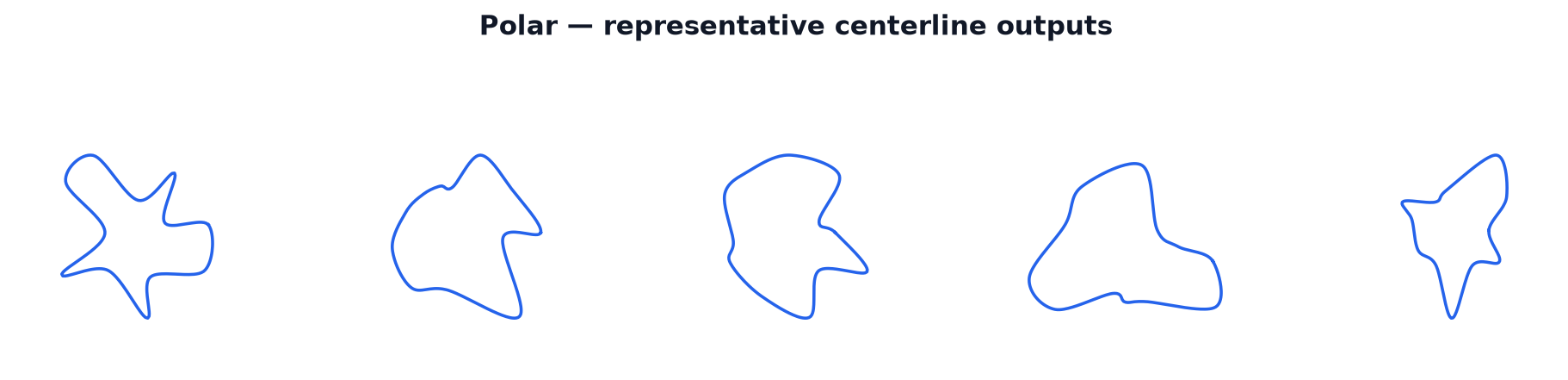
Representative centerlines produced by the polar generator.
How It Works
Control knot sampling. The kernel
_polar_controls_kdrawsK = polar_num_knotscontrol knots using an RNG stream seeded byseeds[e] * 7919 + 17(salt7919is the polar stream constant;+17is the control-specific offset). For each knot indexiin0 … K-1:The nominal angle is
2π i / K.A bounded angular offset
angle_deltais drawn from(-angular_jitter, +angular_jitter)and added: if the jitter fraction is kept below0.5(enforced by Python before launch), the fixed index order remains the sorted angular order without a runtime sort.A radial offset
radial_deltais drawn from(-radial_jitter, +radial_jitter)and applied relative tobase_radius = 1.0. The radius is clamped to at least0.1 * base_radiusso knots never collapse to the origin.
Closed Catmull-Rom spline.
_polar_spline_dense_kevaluates a closed uniform Catmull-Rom spline through theKknots, producingK * num_points_per_segmentdense samples per environment. Samples are endpoint-excluded within each segment; the arc resampler closes the final segment back to the first knot.Arc-length resampling.
_arc_resample_inplace(from the shared pipeline module) converts the dense periodic spline to exactlynum_pointsarc-uniformly spaced points.Bounding-box normalization.
_normalize_centerline_kcenters each environment’s loop by its bounding-box centroid and isotropically rescales so the longest bounding-box dimension equalsscale * 1.44. The1.44constant matches the Bézier baseline’s typical per-environment longest bounding-box extent atscale = 1.0, ensuring thathalf_width, constant spacing, and XPBD relaxation see comparable coordinate ranges across all generators.Validity flag. The generator writes
out_valid_wp = 1for every environment. It has no local polygon fallback; any rare bad geometry is handled by the shared post-relax validity gate.
Math
Knot polar coordinates. For knot index \(i \in \{0, \ldots, K-1\}\):
where \(\alpha\) is the dimensionless polar_angular_jitter fraction (clamped to
[0, 0.45], strictly below 0.5 so the fixed index order remains the sorted angular
order without a runtime sort), \(\delta_r\) is polar_radial_jitter, and
\(R_\text{base} = 1.0\) (a pre-normalization working radius). The Cartesian knot position is:
Closed uniform Catmull-Rom spline. The dense spline is evaluated as:
for \(u \in [0, 1)\) within segment \(i\), with indices taken modulo
\(K\) for the closed (periodic) loop. This is equivalent to the
scalar form implemented in _catmull_rom:
Normalization. After arc-length resampling to \(N\) points, each environment is centered by its bounding-box midpoint and isotropically scaled so that:
where \(\Delta x = x_\max - x_\min\) and \(\Delta y = y_\max - y_\min\).
Parameters
The following TrackGenConfig fields are owned and consumed directly by the
polar generator. For the full field listing and defaults see the configuration
reference (docs/configuration/).
polar_num_knotsNumber of polar control knots \(K\). More knots allow higher-frequency radial variation; fewer produce rounder, more elliptical shapes. Minimum enforced to 4. Default:
12.polar_radial_jitterMaximum fractional radial perturbation \(\delta_r\) applied to each knot. At
0.0all knots sit onbase_radiusand the spline is a near-circle. At the implementation default (0.60 * amplitude) the generator produces substantial radial variety without collapsing radii. Clamped to[0.0, 0.85].polar_angular_jitterMaximum angular offset as a fraction of one knot cell (\(2\pi / K\)). Kept strictly below
0.5(clamped to[0.0, 0.45]) so the fixed knot indices remain in sorted angular order without a runtime sort. Default:0.30.scaleGlobal coordinate scale shared across all generators. The polar generator normalizes its longest bounding-box axis to
scale * 1.44. Larger values produce physically larger tracks.num_points_per_segmentNumber of dense Catmull-Rom samples emitted per control-knot segment before arc-length resampling. Shared with the hull, voronoi, and checkpoint generators. Higher values improve arc-length accuracy at the cost of scratch buffer size.
What Makes It Distinct
The polar generator is the only one of the six that works entirely in polar coordinates from the start:
No Cartesian corner sampling or sorting. Bézier and hull generators both sample random Cartesian corners and sort them by angle around their centroid. The polar generator places knots directly at evenly spaced angles, so the loop is smooth and centered by construction and requires no centroid correction.
Smoothest output, lowest XPBD burden. Because every knot is already in angular order and the spline is closed and uniformly parameterized, the pre-relax geometry is consistently smooth with no tendency toward figure-eight crossings. This translates to the lowest per-step XPBD displacement of the six generators.
No local fallback, fastest hot path. Bézier detects self-crossings and falls back to a corner polygon; hull and voronoi fall back to their anchor polygons. Polar skips all self-intersection detection and all fallback kernels — the hot path is control sampling, spline evaluation, arc resample, and normalization only.
Pure radial shape vocabulary. The shape family is parameterized by radial perturbations around the origin rather than by corner placement, handle lengths, site layouts, or a steering walk. This makes it a strong contrast generator for curriculum or benchmark diversity: it produces tracks that are systematically different in shape character from the corner-family (bézier, hull) and path-family (checkpoint) generators.
No Fourier collapse. An earlier Fourier radial function path was abandoned because it tended toward high-compactness near-circles. The random per-knot radial approach explicitly avoids this by drawing independent radial perturbations per knot.
Fallback and Validity
The polar generator has no local fallback. It does not run
self_intersections_inplace and does not maintain a backup polygon buffer.
Every environment receives out_valid_wp = 1 at generation time regardless
of geometry.
Final geometric validity — turning number, minimum thickness, NaN checks — is decided by the shared post-relax inflation validity gate, which is common to all six generators. Any rare degenerate polar loop (e.g., from extreme jitter settings) is caught and flagged there, not inside the generator.
This design is intentional: the polar parameterization rarely produces self-crossing geometry at default settings, so the cost of a local fallback path is not justified. The XPBD relaxation stage further smooths out mild overlap before the validity gate.