Generating a Batch of Tracks
TrackGenerator produces a whole batch of closed, constant-width racing
tracks in one call: a centerline generator draws a centerline per environment,
the pipeline resamples it at constant arc spacing, XPBD-relaxes it so it is
inflatable, and inflates it into a road band. This tutorial walks the end-to-end
workflow — build a config and RNG, call generate(), read the output arrays,
work with the real points per environment — and then drives an agent against the
finished tracks with the built-in collision engine.
Prerequisites
Install track_gen with the dev extra (pulls in warp-lang, torch,
and the rest of the development dependencies):
uv pip install -e ".[dev]"
Building the Track Config and RNG
TrackGenConfig holds every generation parameter. The two required fields are
num_envs (batch size) and device ("cpu" or "cuda").
half_width is the road half-width in world units and defaults to 0.1.
import warp as wp
wp.init()

from track_gen import TrackGenerator, TrackGenConfig, PerEnvSeededRNG

E, device = 64, "cuda"  # or "cpu"
config = TrackGenConfig(num_envs=E, half_width=0.03, device=device)
rng = PerEnvSeededRNG(seeds=0, num_envs=E, device=device)
PerEnvSeededRNG derives one independent seed per environment from the master
seed. Passing an integer broadcasts the same master seed across all environments;
passing a 1-D array of length E sets per-environment seeds directly.
Generating the Track Batch
generator = TrackGenerator(config, rng)
track = generator.generate()
TrackGenerator.__init__ pre-allocates all GPU buffers (generator scratch,
pipeline scratch, seed buffers, and the persistent Track) exactly once. On
cuda, the first generate() call warms the kernels, captures the entire
pipeline into a single replayable wp.Graph, and immediately replays it.
Subsequent calls copy the updated seeds into the fixed seed buffer and replay the
same graph.
Note
TrackGenerator is fixed-batch: generate() always produces exactly
config.num_envs tracks. Passing an explicit environment-id sequence is not
supported because the CUDA graph captures one fixed batch shape.
Reading the Output Fields
track is a Track dataclass whose fields are flat Warp arrays. Use
wp.to_torch to get PyTorch views:
center = wp.to_torch(track.center).view(E, config.N_max, 3)
outer  = wp.to_torch(track.outer).view(E, config.N_max, 3)
inner  = wp.to_torch(track.inner).view(E, config.N_max, 3)
valid  = wp.to_torch(track.valid).bool()
count  = wp.to_torch(track.count)
The full field table:
Field |
Shape |
Meaning |
|---|---|---|
|
|
Border / centerline / border points. All three are index-aligned: the same
cross-section normal passes through |
|
|
Unit tangent and left-normal along the centerline. |
|
|
Cumulative arc length (0 at index 0). |
|
|
Closed-loop perimeter for each environment. |
|
|
Per-track validity flag. Invalid tracks failed a geometric check (turning, thickness, NaNs, or road self-overlap). |
|
|
Real point count per track. Slots at index |
Slicing Real Points
track_gen uses constant-spacing output: each track is emitted at a
constant arc spacing rather than a fixed point count. The per-track point count
is count[e] = floor(perimeter / spacing) + 1, capped at N_max. Slots
beyond count[e] are filled with NaN.
To work only with the real arc-uniform points for a given environment:
# Real centerline points for environment 0
n0 = int(count[0])
center_env0 = center[0, :n0]   # shape [n0, 2]
outer_env0  = outer[0,  :n0]   # shape [n0, 2]
inner_env0  = inner[0,  :n0]   # shape [n0, 2]
Track Figure
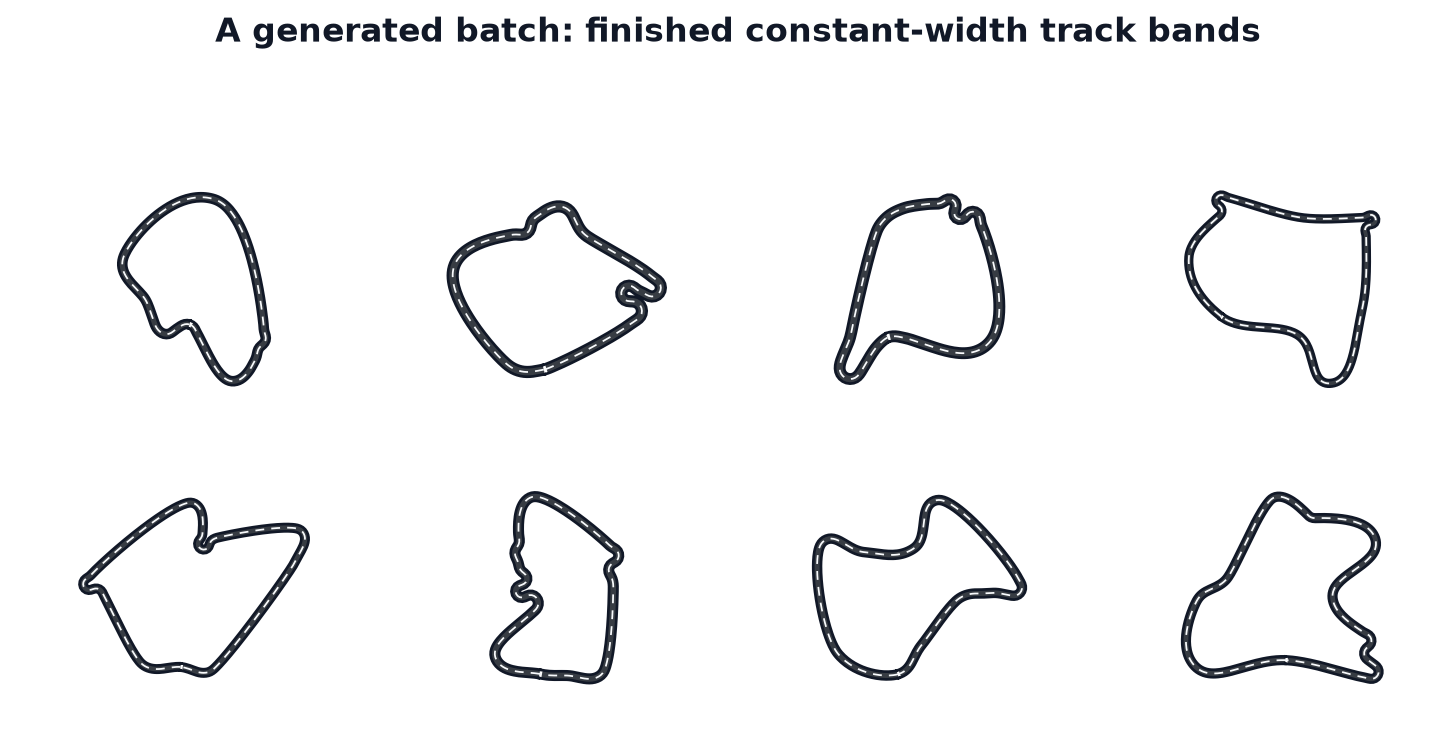
The end product of generate(): finished constant-width road bands, each a
filled band between the outer and inner borders with the center
line dashed through it. Every band came from one deterministic batch at the
default half_width=0.03 geometry.
Choosing spacing and N_max
The default spacing is None, which auto-sets to 0.6 * half_width.
N_max is the per-track point capacity: size it so that
N_max >= max(perimeter) / spacing + 1 and no track is silently truncated
(the default fat-band configuration leaves ample headroom). A smaller
spacing yields a denser, smoother polyline at the cost of more points per
track (and a larger required N_max); a larger spacing is cheaper but
coarser. See Resample — constant-spacing arc-length resampling for the constant-spacing
contract in depth.
Relaxing the Centerline
Between the constant-spacing resample and the inflation, the pipeline runs an
XPBD relaxation pass that opens self-approaches and rounds under-radius corners
so the constant-width band is inflatable. It is on by default and controlled by
the relax_* fields (relax_enable, relax_iters, relax_accel,
relax_sep_every, the smoothing tail, …). The defaults are tuned; reach for
these knobs only to trade yield against per-batch cost.
See also
Track relaxation — overview documents the relaxation stage — why a raw
centerline is not inflatable, the thickness gate that decides valid, and
every relax_* knob with its effect on yield and cost.
Device Choice (cpu / cuda)
The same TrackGenerator API runs on both devices; only the device string
in TrackGenConfig changes. On cpu every generate() runs the pipeline
eagerly (no graph). On cuda the first call captures the pipeline into a
replayable wp.Graph and later calls are fast replays — the natural choice for
a batched RL loop. See Integrating the CUDA Graph into a Batched RL Sim Loop for the fixed-batch
contract, capture-vs-replay mechanics, and per-generator replay timings.
Buffer Reuse and Snapshots
The same Track instance and its underlying Warp arrays are reused on
every generate() call. If you need an independent snapshot — for example, to
keep the tracks from one episode while generating a fresh batch — call
track.clone():
snapshot = track.clone() # independent copy; safe to keep across generate()
Converting with wp.to_torch
wp.to_torch returns a zero-copy PyTorch view of the underlying Warp
buffer. The view is only valid as long as the backing Track (or clone) is
alive. For a persistent tensor, call .clone() on the PyTorch side as well:
center_torch = wp.to_torch(track.center).view(E, config.N_max, 3).clone()
Driving Against the Track: Collision for RL
Generation gives you the geometry; an RL or controller loop also needs to know, each step, is the agent still on the track? and how far along has it got? The Course facade bundles generation with the built-in out-of-bounds collision checker and the checkpoint/progress tracker in one object, so you never wire those together by hand. Its lifecycle is construct → bind → generate → step / reset.
Build a Course in track mode, bind the sim’s own state buffers (they are
read in place every step), generate the batch, then in the step loop read
contacts.oob for the out-of-bounds flag and the progress events for
checkpoint rewards:
import numpy as np
import warp as wp
wp.init()

from track_gen import TrackGenConfig
from track_gen.course import Course, CourseConfig

E, device = 4, "cpu"

course = Course(CourseConfig(
    mode="track",
    gen=TrackGenConfig(num_envs=E, half_width=0.03, device=device),
    seeds=7,
    collision="segments",          # "segments" (exact) or "sdf"; None = no OOB check
    checkpoint_spacing=0.6,
    max_checkpoints=64,
))

# Bind the sim's own buffers: position (vec3f) drives progress; orientation
# (quatf) + half_extents (vec2f, planar box) are the oriented collision box.
# The sim writes these in place each step.
position     = wp.zeros(E, dtype=wp.vec3f, device=device)
orientation  = wp.array(np.tile([0.0, 0.0, 0.0, 1.0], (E, 1)).astype(np.float32),
                        dtype=wp.quatf, device=device)   # identity quats
half_extents = wp.array(np.full((E, 2), 0.02, np.float32),
                        dtype=wp.vec2f, device=device)
course.bind(position=position, orientation=orientation, half_extents=half_extents)

track = course.generate()          # whole batch + checkpoint resample + progress reset

for step in range(40):
    # sim.step() writes `position` (and `orientation`) in place here.

    res    = course.step()                 # events + contacts, no args
    oob    = res.contacts.oob.numpy()      # [E] int32: 1 == out of the drivable band
    passed = res.events.passed.numpy()     # [E] int32: crossed a checkpoint this step
    dist   = res.events.dist_to_next.numpy()   # [E] float32: distance to next checkpoint

    reward = 10.0 * passed - 5.0 * oob     # pass bonus, OOB penalty (reward shaping)

# Per-env respawn on the SAME course: clear progress only where mask[e] == 1.
done = np.zeros(E, np.int32)
done[0] = 1
course.reset(wp.array(done, dtype=wp.int32, device=device))

# New courses for everyone: whole-batch regenerate + full progress reset.
course.generate(seeds=123)
contacts.oob is the reward/termination signal (res.contacts is a
BoxContact that also carries signed distance, the nearest boundary
point, and the inward normal for contact response). res.events gives the
progress signals — passed for a pass bonus, dist_to_next for a
negative-delta-distance shaping term, and progress for the total checkpoints
cleared since the last reset.
Collision backend
Track mode accepts collision="segments" (exact boundary scan, the default —
no precompute, reads regenerated tracks automatically), "sdf" (baked
signed-distance grids: O(1) queries after a per-regeneration bake, worth it when
a batch serves many queries between regenerations and only the OOB flag and
approximate clearance are consumed), or None (progress-only, no OOB check).
The "discs" obstacle checker is the separate gate-post collision used in
gates mode (post_radius > 0), not a track-mode OOB backend. See
Out-of-bounds & obstacle collision for the backend trade-offs and measured numbers, and
Checkpoints & progress for the checkpoint/reward contract.
CUDA-graph composability
step() and reset() are warp-native and capture-ready: flip the single
shared capture flag with track_gen.set_capturing(True) and the whole step —
progress update plus collision query — records into your own sim graph alongside
the physics. Keep writing into the SAME bound buffers after capture (rebinding
leaves the captured graph reading the old pointers). See
Integrating the CUDA Graph into a Batched RL Sim Loop for the capture-and-replay pattern.
Putting It All Together
import warp as wp
wp.init()

from track_gen import TrackGenerator, TrackGenConfig, PerEnvSeededRNG

E, device = 64, "cuda"
config = TrackGenConfig(num_envs=E, half_width=0.03, device=device)
rng    = PerEnvSeededRNG(seeds=0, num_envs=E, device=device)

generator = TrackGenerator(config, rng)
track     = generator.generate()

center = wp.to_torch(track.center).view(E, config.N_max, 3)
outer  = wp.to_torch(track.outer).view(E, config.N_max, 3)
inner  = wp.to_torch(track.inner).view(E, config.N_max, 3)
valid  = wp.to_torch(track.valid).bool()
count  = wp.to_torch(track.count)

# Slice real points for env 0
n0 = int(count[0])
print(f"env 0: {n0} real points, valid={bool(valid[0])}")
print("centerline:", center[0, :n0])