Checkpoint Generator
The checkpoint generator produces organic, continuously undulating closed loops by steering
a bounded-turn path through a ring of random radial checkpoints. It is the only generator
in track_gen that derives its shape from a proportional-gain steering walk, making it the
natural fit for CarRacing-style circuits that flow continuously around the track rather than
snapping between corner anchor points.
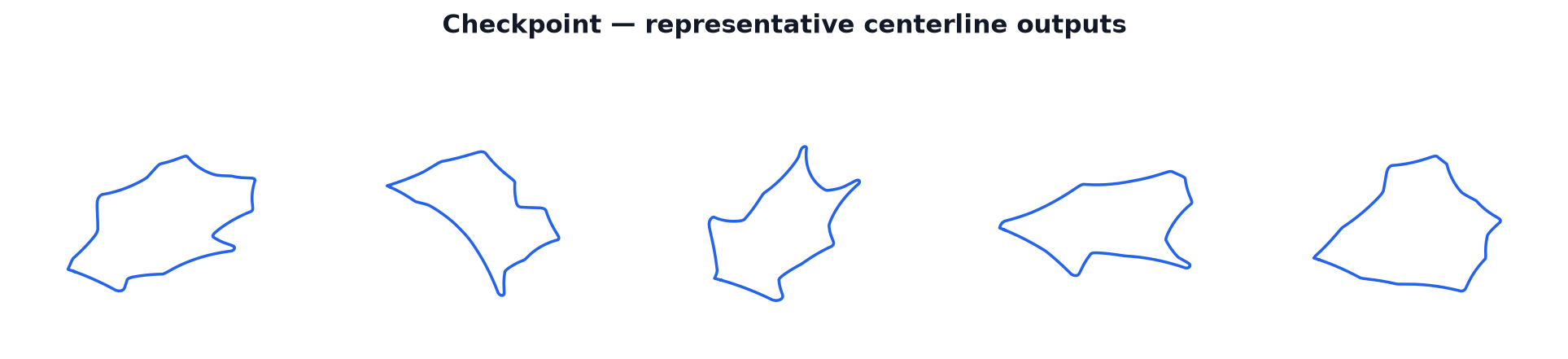
Tracks produced by the checkpoint generator (generator="checkpoint").
How It Works
Sample checkpoint ring.
_sample_checkpoints_kdrawsC = checkpoint_countcheckpoints, one per angular slot, at angles2*pi*c/C + jitter(bounded bycheckpoint_angle_jitter * slot, approximately angle-ordered so the steered path winds exactly once around) on radii drawn uniformly from[checkpoint_radius_min_frac * R, R]withR = 1. The sampling is repeated independently for each of theKdecorrelated candidates using per-candidate RNG salt offsets.Fixed N-step bounded-turn steering walk.
_steer_kwalks a fixednum_points-step open path. The step lengthdl = ring_perimeter / N(wherering_perimeteris the closed polygon perimeter over the sampled checkpoints) pins the walk to approximately one full lap without an over-generate-and-trim step. The walk starts at checkpoint 0 heading toward checkpoint 1. At every step the proportional steering errorerr = wrap(bearing - theta)is computed, the heading change is clamped to+/- checkpoint_turn_rate, and the position is advanced bydl * (cos(theta), sin(theta)). The target checkpoint index advances by one when the current position is withincheckpoint_lookahead_frac * Rof the current target, cycling moduloCso the walk chases each checkpoint in order.Additive heading-ramp closure.
_close_heading_ramp_kcloses the open steered path to turning number 1 without altering the local curvature character of the loop. It computes the sum of all wrapped heading increments over the closed edge ring, then adds a constant drift(2*pi - net_turn) / Nto every step’s heading increment so the net cumulative turn is exactly2*pi. Headings are rebuilt from the corrected increments, the mean edge vector is subtracted (gap-distribution closure), and positions are recovered by cumsum and then recentered by their centroid. Two alternative closures were rejected: multiplicative rescaling of heading increments flattened the loop toward a blob, and gap-closing in position space produced self-crossings.Best-of-K candidate selection. With
checkpoint_best_of_k(K, default 4) greater than one,Kindependently seeded candidates are generated per environment in parallel._select_best_kperforms a deterministic argmin over each environment’sKper-candidate self-intersection counts, keeping the least-crossing candidate (ties broken by the lowest candidate indexk). WhenK = 1a direct copy (_copy_single_k) is used instead, skipping the intersection scoring entirely.K = 4gives approximately zero pre-relax self-intersections at the default configuration.Optional single-crossing clip fallback. When
checkpoint_clip_fallback = True(off by default),_clip_assemble_krescues any selected centerline that still contains a self-crossing by finding the first crossing segment pair, computing the intersection pointP, splitting the loop into an inner and an outer sub-loop atP, and keeping the longer of the two simple sub-loops by arc length. The kept sub-loop is then arc-resampled back tonum_points. This is a capture-time Python branch; the CUDA graph stays fixed regardless.Bounding-box normalization.
_normalize_centerline_kcenters each environment by its bounding box and isotropically scales the longest bounding-box dimension toscale * 1.44, matching the Bezier baseline’s typical longest extent so the shared resample, relaxation, and inflate stages see comparable coordinate ranges across generators.
Math
Checkpoint placement. Checkpoint c (zero-indexed, c = 0, ..., C-1) is placed
at angle and radius:
The jitter bound keeps the sequence strictly angle-monotone (no angular slot is crossed), so the steered path is guaranteed to wind once around.
Steering step. The step length is fixed to the checkpoint polygon perimeter divided by
N:
where indices wrap modulo C. At each step:
with \(g = \texttt{checkpoint\_steer\_gain}\) and \(\tau = \texttt{checkpoint\_turn\_rate}\). The heading is updated as \(\theta \leftarrow \theta + \Delta\theta\) and the position advances by \(dl \cdot (\cos\theta,\, \sin\theta)\).
Additive closure ramp. Let \(\sum_i \Delta\theta_i\) be the sum of all wrapped heading increments around the closed edge ring. A constant drift is computed and added to every step:
After applying the drift, the net cumulative heading change is exactly \(2\pi\) (turning number 1, no inner loops). Because the drift is additive — not a rescaling of existing increments — the steered sweeps and inlets in the local curvature are preserved. Positions are then recovered by integrating unit-length edge vectors and subtracting the mean edge (gap-distribution closure), followed by recentering by the centroid.
Parameters
All parameters below are fields on TrackGenConfig and apply only when
generator = "checkpoint". See the configuration reference for types, defaults, and
validation rules.
checkpoint_count(int, default 12)Number of radial checkpoints
C. Must be >= 3. More checkpoints produce wavier tracks with more chicanes; fewer produce calmer, rounder loops. The CarRacing canonical default is 12.checkpoint_radius_min_frac(float, default 0.33)Inner-radius fraction for checkpoint placement. Checkpoint radii are drawn from
U(checkpoint_radius_min_frac * R, R)withR = 1. Must be in[0, 1). The CarRacing canonical value 0.33 gives the characteristic inlets.checkpoint_angle_jitter(float, default 0.55)Angular jitter as a fraction of the per-checkpoint angular slot
2*pi/C. Must be below 1.0 (enforced in Python before launch) so each checkpoint stays within its nominal angular slot. Values above 0.5 allow adjacent checkpoints to swap angular positions; the steering walk still completes approximately one lap by chasing checkpoints in index order, but strict angle-monotonicity is not guaranteed at the default of 0.55. Larger values produce more irregular spacing and more varied corner geometry.checkpoint_turn_rate(float, default 0.42)Maximum heading change in radians per steering step. Bounds path curvature: too large allows sharp kinks; too small prevents the path from tracking tight inlets.
checkpoint_steer_gain(float, default 0.65)Proportional steering gain toward the current target bearing. Coupled to one lap by the fixed step length
dl; values in(0, 1]are typical. Higher values chase each checkpoint more aggressively.checkpoint_lookahead_frac(float, default 0.16)Advance-to-next-checkpoint threshold as a fraction of outer radius
R. The walk moves to the next checkpoint once withincheckpoint_lookahead_frac * Rof the current target, preventing the path from stalling at each checkpoint.checkpoint_best_of_k(int, default 4)Number of decorrelated candidates generated per environment. Must be >= 1. The candidate with the fewest self-intersections is selected (deterministic argmin, ties broken by lowest candidate index).
K = 4is the bounded, graph-capturable replacement for CarRacing’s unbounded reject-retry loop.checkpoint_clip_fallback(bool, defaultFalse)Opt-in single-crossing clip fallback. When
True, the first self-crossing of the selected centerline is clipped: the loop is split at the intersection point, the longer simple sub-loop is kept, and it is arc-resampled back tonum_points. Must be set consistently betweenalloc_scratchandgeneratesince the clip buffers are only allocated when the flag isTrueat alloc time.
What Makes It Distinct
The checkpoint generator is the only steering-walk generator in track_gen.
Whereas the Bezier, hull, polar, and Voronoi generators all start from a set of anchor
points and smooth or interpolate between them — producing shapes that are broadly
star-shaped around an anchor centroid — the checkpoint generator builds its shape by
integrating a bounded-curvature heading signal. The result is an organic, continuously
undulating loop without prominent spoke directions or angular corner signatures.
The additive heading-ramp closure is the key design decision that separates this generator from a naive steering loop. Closing in position space (e.g., linearly interpolating toward the start point) introduces self-crossings. Multiplicative rescaling of heading increments (scaling all turns uniformly so they sum to \(2\pi\)) flattens the local curvature and collapses the organic shape toward a near-circle blob. The additive drift preserves the steered sweeps and inlets while guaranteeing turning number 1.
Best-of-K selection is the graph-capturable analogue of CarRacing’s unbounded
reject-retry: rather than re-generating until a clean loop is found, K decorrelated
candidates are generated in one fixed-shape pass and scored by self-intersection count.
At the default K = 4 and default steering parameters, the pre-relax self-intersection
rate is near zero without any host-side branching.
The checkpoint generator sits in the medium-high compactness range (approximately 0.61), between the compact Voronoi family and the lower-compactness Bezier and hull families. Its continuously curving character and lack of straight sections or sharp corners make it well-suited to CarRacing-style reinforcement-learning environments.
Fallback and Validity
The checkpoint generator’s primary quality mechanism is best-of-K selection:
generating K candidates per environment and keeping the least-self-intersecting one.
At K = 4 with default parameters, pre-relax self-intersections are effectively
eliminated without any host-side retry loop.
The opt-in clip fallback (checkpoint_clip_fallback = True) provides a
shape-preserving secondary rescue for any remaining self-crossers in the selected
centerline. It is off by default (like the polar generator, which also has no
generator-local fallback); the downstream post-relax validity gate handles any residual
bad geometry.
As with all generators, out_valid_wp is filled with 1 for every environment at
generation time. Final geometric validity — turning number, minimum thickness, NaN
checks, and optional border intersection checks — is decided later by the shared
inflate_warp stage after constant-spacing resample and XPBD relaxation. The
generation flag is a stage flag, not a quality certificate.