Gate relaxation — collision solve
Drone-style gate sequences (GateGenerator, tutorial at
Generating Gate Sequences for Drone Courses) run their own gate self-collision relaxation, separate
from the XPBD track relaxation documented on the other pages in this section. It is a
small per-env pairwise separation that pushes overlapping gates apart before tangents
and frames are computed. This page covers why it exists, the sphere model and its
target distance, the Gauss-Seidel solve semantics, its determinism, the one knob that
controls it, and how it behaves under CUDA-graph capture.
Why gates need it
The gate path does not run resample, XPBD relaxation, or inflation — it emits the
centerline-generator corner anchors directly as gate centres. Raw anchors routinely land close
together or exactly coincident (two sampled anchors in the same grid cell, a
tight-corner cluster). Without separation the resulting sequence has gates overlapping
in the plane: unusable as a drone course, and — with a positive gate_width — prone
to crossing gate bars that fail the validity check. The collision solve spreads
overlapping gates to a minimum centre spacing so the sequence is a clean, traversable
course.
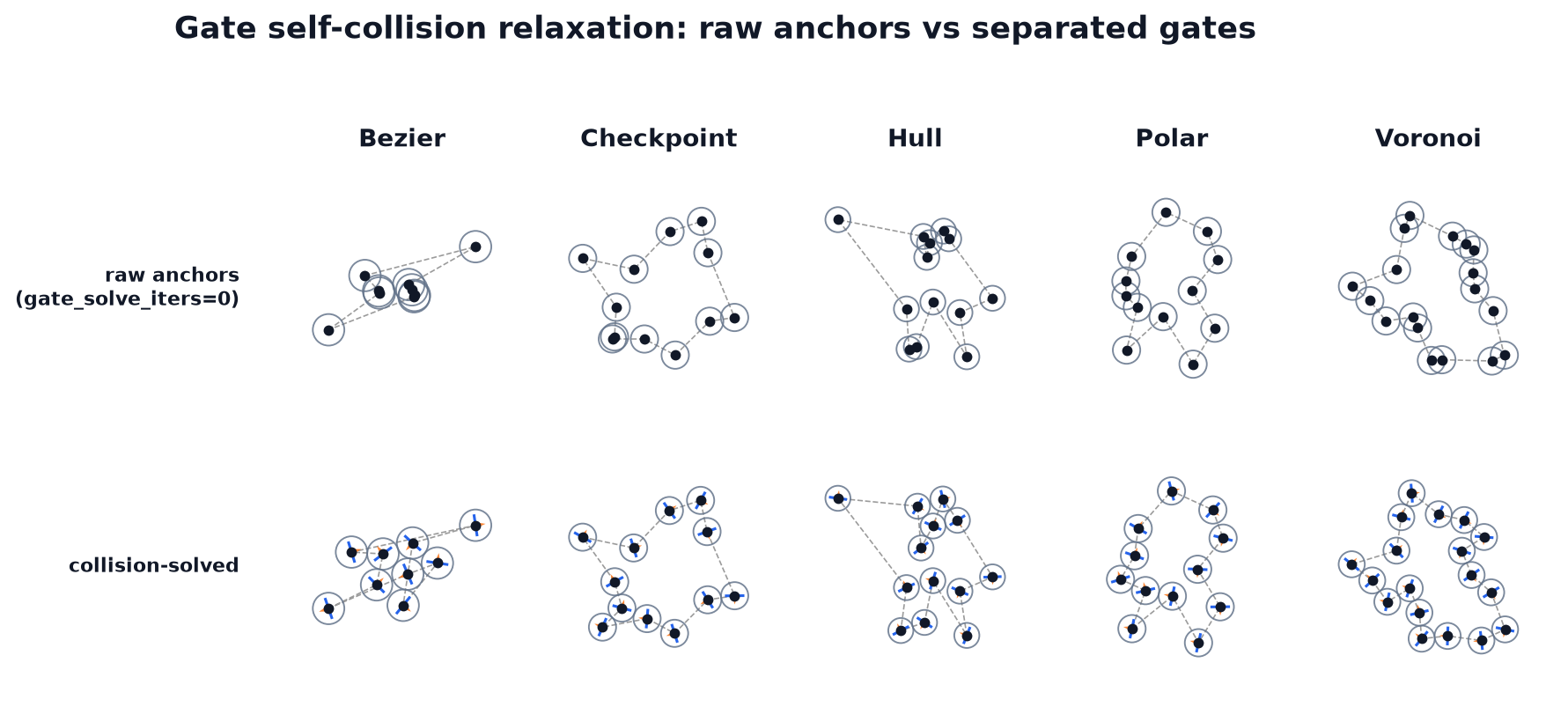
Gate self-collision relaxation: raw anchors (top, gate_solve_iters=0) versus
the separated gates (bottom), with gate tangents and gate_width bars.
The sphere model and target distance
Each gate centre is treated as a disk (a 2-D sphere) of radius gate_radius. Two
gates overlap when their centres are closer than the sum of the two radii, so the
target centre-to-centre distance is twice the radius. _gate_center_distance derives
it from a single config field:
so at the default gate_radius = 0.025 the target centre spacing is 0.05 in
normalized track coordinates. gate_radius is the only config field that feeds the
target; gate_width is a separate visual/collision half-width for the gate bar and
does not enter the separation target.
Where it runs in the pipeline
The solve is invoked from _run_gate_pipeline in track_gen/_src/warp_gate.py,
after the generator has produced ordered, normalized anchors and before frames and
validity. Every native gate generator (bezier, hull, polar, voronoi,
checkpoint) routes through this one path, so the stage order is uniform:
raw anchors → ordering (ccw / raw / random_pairs) → bbox normalization
    → SPHERE RELAXATION → recompute tangents → frames + validity
Concretely, _run_gate_pipeline calls relax_gate_spheres only when
gate_solve_iters > 0 and the target distance is positive, then recomputes tangents
from the moved positions (tangents_from_positions) before finalize_gate_sequence
writes the normals, endpoints, and per-sequence validity. Because separation can push
gates outward, the final bounding box may expand beyond the normalized extent to satisfy
the requested spacing.
The solve: per-env sequential Gauss-Seidel
relax_gate_spheres launches _relax_gate_spheres_k with one thread per env
(dim = E). Each thread owns one gate sequence and runs the whole separation loop
in-kernel:
For up to
iterationsrounds, it scans every ordered gate pair \((i, j)\), \(j > i\), over the env’s real gatecount.A pair with centre distance
dist < target_distanceis pushed apart symmetrically by half the deficit each:\[\text{correction} = \tfrac{1}{2}\,(d_{\text{target}} - \text{dist})\,\hat{n}, \qquad p_i \mathrel{-}= \text{correction},\quad p_j \mathrel{+}= \text{correction},\]where \(\hat{n}\) is the unit vector from \(p_i\) to \(p_j\).
Positions are written back in place inside the pair loop, so later pairs in the same round already see the corrections applied by earlier pairs. That is Gauss-Seidel iteration, unlike the track solver’s Jacobi double-buffering.
Each round tracks whether any pair moved; a round that moves nothing triggers an early exit from the iteration loop (the sequence is already separated).
Five bezier gate sequences whose raw anchors (gate_solve_iters=0) are heavily
overlapping (10-15 pairs inside the separation target each), evolving round by round
through the Gauss-Seidel sphere separation at an illustrative gate_radius=0.13
(target spacing 0.26; the default radius is 0.025) with gate_width=0.16
bars. Because the coincident-pair tie-break is indexed by the round index — not the
total budget — a run with gate_solve_iters=k executes exactly the first k rounds
of a longer run, so each frame is generated afresh at budget k and is a true
snapshot of the same trajectory (the raw anchors are asserted bit-identical across two
generations). Each panel gains a converged tag once its state stops changing — the
per-env early exit in action; the round budget only bounds the loop. Regenerate with
python -m viz.render_relaxation_video --gates (needs ffmpeg).
Contrast with the track XPBD solver
The track solver (see Track relaxation — the solver) is deliberately the opposite design:
Track relaxation |
Gate relaxation |
|
|---|---|---|
Parallelism |
E-wide, thread-per-bead ( |
thread-per-env ( |
Update order |
Jacobi — reads previous-sweep buffer, double-buffered |
Gauss-Seidel — in-place, later pairs see earlier moves |
Loop structure |
Fixed sweep count, one kernel launch per sweep |
Single launch; rounds and pairs looped inside the kernel |
Termination |
Fixed iteration budget |
Early exit when a round moves nothing |
Why the flip is the right trade-off: a track carries hundreds of beads
(\(N_\text{max}\)), so parallelizing across beads is what keeps the sweep cheap, and
Jacobi double-buffering is what makes that bead-parallel update order-independent and
graph-capturable. A gate sequence carries only dozens of gates (default
max_gates = 32), so the \(O(G^2)\) pair loop is tiny (a few hundred to a thousand
comparisons per round) and there is no need to parallelize across gates — one thread per
env already saturates the batch dimension E. Running the whole solve inside a single
thread means Gauss-Seidel updates in place with no double-buffering, and the early
exit is free (a per-thread break) rather than a host-side sync that would break
graph capture.
Determinism: the coincident-gate tie-break
When two gates are exactly coincident (dist at or below 1e-8) there is no
well-defined separation direction. The kernel synthesizes a deterministic pseudo-random
one from an angle hash of the pair and iteration indices:
The hash depends only on the gate indices (i, j), the round it, and the env
e — no RNG state — so the separation is bit-for-bit reproducible across runs and
across CUDA-graph replays. Distinct coincident pairs and successive rounds get distinct
directions, so a cluster of stacked gates fans out rather than collapsing along one axis.
The gate_solve_iters knob
The iteration budget is GateGenConfig.gate_solve_iters (default 8, validated
>= 0). It is the iterations upper bound on the round loop; the early exit means
well-separated sequences finish in fewer rounds. Setting ``gate_solve_iters = 0``
disables the solve entirely — relax_gate_spheres returns immediately, and the gate
generators skip both the separation launch and the tangent recompute. That is the mode
to use when inspecting the raw ordered, normalized anchors before separation (close gates
may still overlap). The target distance is governed separately by gate_radius;
gate_radius = 0 also short-circuits the solve.
Graph capture and zero-alloc
The solve is a single wp.launch of a fixed-shape kernel: the launch dimension
(E) and the iterations bound come from the config, not from data, so the launch
sequence is data-independent and captures cleanly into the gate pipeline’s wp.Graph.
The in-kernel early-exit break is per-thread control flow inside the kernel — it
does not vary the host launch sequence, so it is compatible with capture. As elsewhere in
warp_gate.py, _sync is a no-op while _CAPTURING is set, so no host
synchronization is issued during capture. The separation runs in place on the existing
position buffer with no per-call allocation.
See also
Generating Gate Sequences for Drone Courses — the end-to-end gate-generation recipe and output fields, including the runtime section that drives gates for RL.
The Course facade — the runtime side:
Coursein gates mode turns these separated gates into checkpoints and optional gate-post collision.Track relaxation — overview, Track relaxation — the solver — the XPBD track relaxation stage this solve is deliberately contrasted with.